



The best backyard cookout games do one thing better than fancy party tricks: they survive a yard full of people holding paper plates, dodging the grill, and trying not to spill coleslaw on the grass. A game that works in this setting has to be quick to explain, hard to wreck, and forgiving when the lawn is patchy or the wind starts nudging everything off course.
That smoky, slightly charred cookout mood changes the rules. You do not need a polished activity that steals the whole afternoon. You need something that can sit beside the cooler, come alive between bites, and still make sense after the first round of potato salad and the second trip to the serving table.
I’ve always liked games that feel a little rugged. Cornhole with scuffed bags, bocce rolling through imperfect grass, a ring toss made from whatever cones and buckets are already around — those are the games people keep returning to because they fit the pace of a real backyard. The good ones never ask for silence or perfect coordination. They just get people laughing while the charcoal does its work.
Why These Games Earn Their Space in the Yard
-
They fill the dead space between arrivals and dinner. The first 20 minutes of a cookout can get awkward fast if everyone is just standing around the cooler. A simple game gives people something to do with their hands while the grill warms up and the first round of drinks gets poured.
-
They survive real backyard conditions. A good cookout game doesn’t collapse because the lawn slopes, the deck boards wobble a little, or somebody’s shoes are sinking into damp grass near the hose. That’s the whole point: outdoor games should feel sturdy enough for actual outdoor life.
-
They give mixed-age groups one thing to share. Kids don’t need one game and adults another if you choose carefully. Lower the throwing line, shorten the round, or add an easier target, and the same setup suddenly works for a six-year-old, a teenager, and the person who insists they “used to be good at this.”
-
They keep people moving without turning the yard into a track meet. Nobody wants a backyard obstacle course while burgers are sizzling. The right games ask for a few steps, a toss, a laugh, and then a chance to sit back down.
-
They make conversation easier, not harder. A game that runs in the background gives shy guests something to watch before they jump in. It also gives the loud ones something to focus on besides talking over everyone else.
-
They scale up better than most party ideas. A cookout game can handle four people, then eight, then a rotating line of cousins and neighbors who appear whenever the score gets close. That flexibility is gold.
The Yard Layout That Keeps Games Away From the Grill Smoke
A backyard cookout starts going sideways the moment the food path and the game path become the same path. People carrying plates should never have to dodge a flying beanbag. And nobody should have to choose between a winning toss and a hot tray of ribs.
I like to split the yard into three zones: a grill zone, a food zone, and a game zone. The grill zone should stay clear and boring. No loose chairs, no running kids, no cornhole boards leaning against the propane tank. The food zone needs a stable table, a trash can, napkins, and a little breathing room. The game zone belongs far enough away that a missed throw does not land in the potato salad.
A simple layout that works
- Put the grill at least 10 feet from walls, railings, branches, and anything flammable.
- Leave a straight walking lane between the kitchen door, the serving table, and the grill.
- Keep the main game area on the flattest patch of grass you have, even if it’s not the prettiest one.
- Place seating just outside the game lane, not inside it.
- If the yard is small, choose one active game and one seated game, not three active ones fighting for space.
A chalk line or a pair of small cones can save you from a lot of mild chaos. So can a cheap measuring tape. Cornhole feels different at 27 feet than it does at 18, and bocce becomes a different beast the second the slope gets steep. The more clearly you define the space before people arrive, the less time you spend saying, “Wait — don’t stand there.”
Sun angle matters too. A west-facing yard can turn into a bright, squinting mess late in the day, and nobody plays well when they’re staring into glare. Put games where the shade will land later, not just where the ground looks nicest at noon. That little bit of planning pays off around the second round of burgers.
Fast Warm-Up Games for Guests Who Arrive Hungry
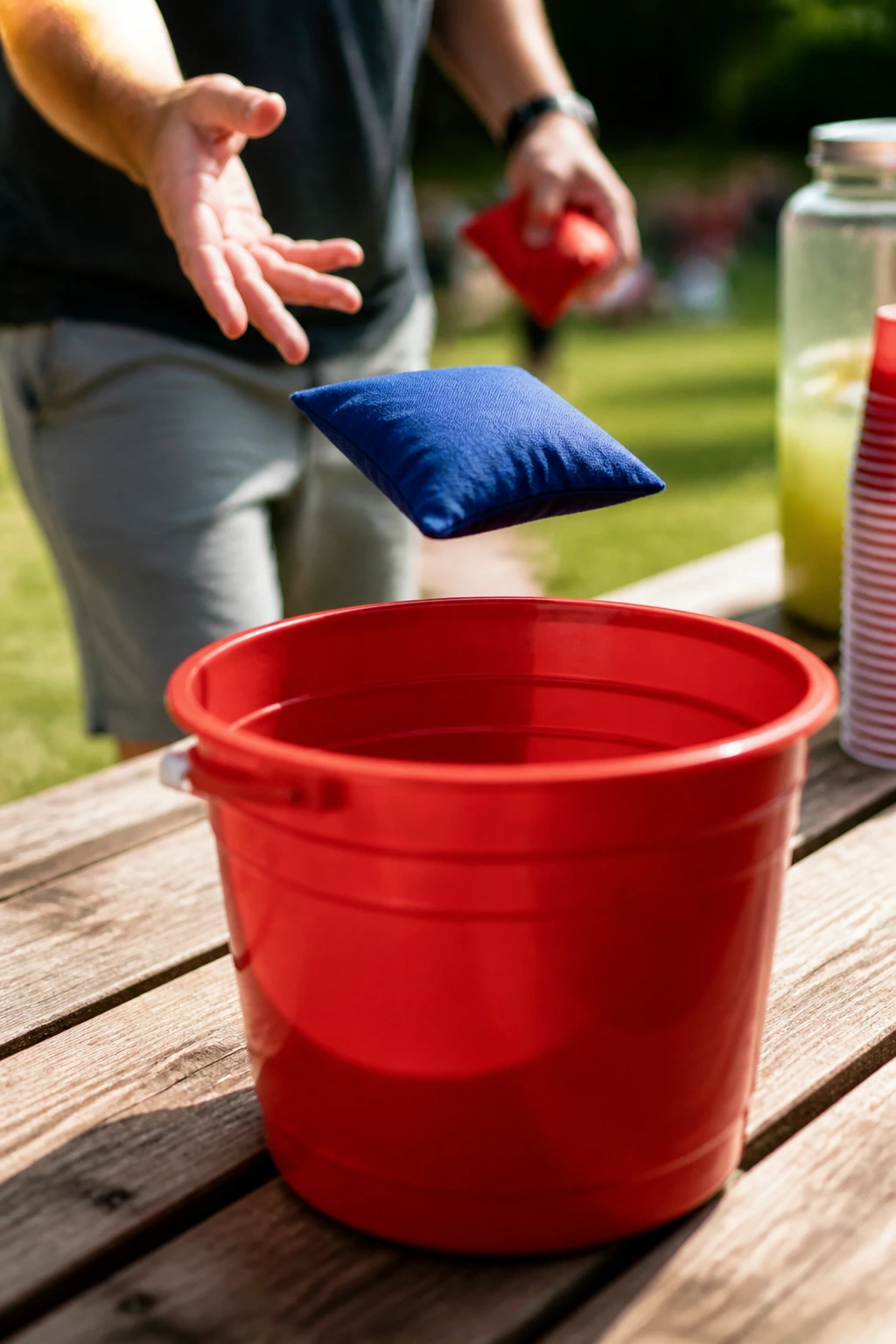
The first game at a cookout should feel like a handshake, not an exam. If it takes longer than a minute to explain, it’s too much for the opening round. Hungry people get restless. Kids get noisy. Adults start claiming they’re “just watching,” which is usually code for I haven’t understood the rules yet.
I prefer games that need one simple object, one target, and one obvious score. Beanbag tosses, ring tosses, and quick target games are perfect because nobody has to stand in a circle for a rules lecture. You set it up, point, and let the first throw teach the rest.
What works best here
Beanbag-to-bucket games are underrated. Set three buckets at different distances — maybe 5, 8, and 12 feet — and assign higher points to the farthest one. Now the game has tension, but it still looks friendly. Use soft beanbags or rolled socks if you’re improvising. Hard balls bounce too far and turn the first round into a chase scene.
Bottle ring toss is another solid opener, especially if you want something that can be played while standing near the table. Use sturdy plastic bottles filled with a little sand or water so they don’t tip over as soon as someone brushes past. Keep the rings larger than people expect. Tiny rings make the game feel fussy, and fussy is the enemy of a cookout.
Giant Jenga works best when you want a little suspense without much athletic effort. The trick is to place it somewhere level and away from foot traffic. A wobbly deck board can make the tower look haunted before anyone touches it. Put the pieces back in a basket after each collapse so the pile doesn’t wander.
These warm-up games do not need a long lifespan. Five minutes is enough. Ten if the crowd is chatty. The whole point is to get bodies moving and let the room find its own tempo before the food hits the table.
Games That Let Kids, Teens, and Adults Play Without Splitting the Party
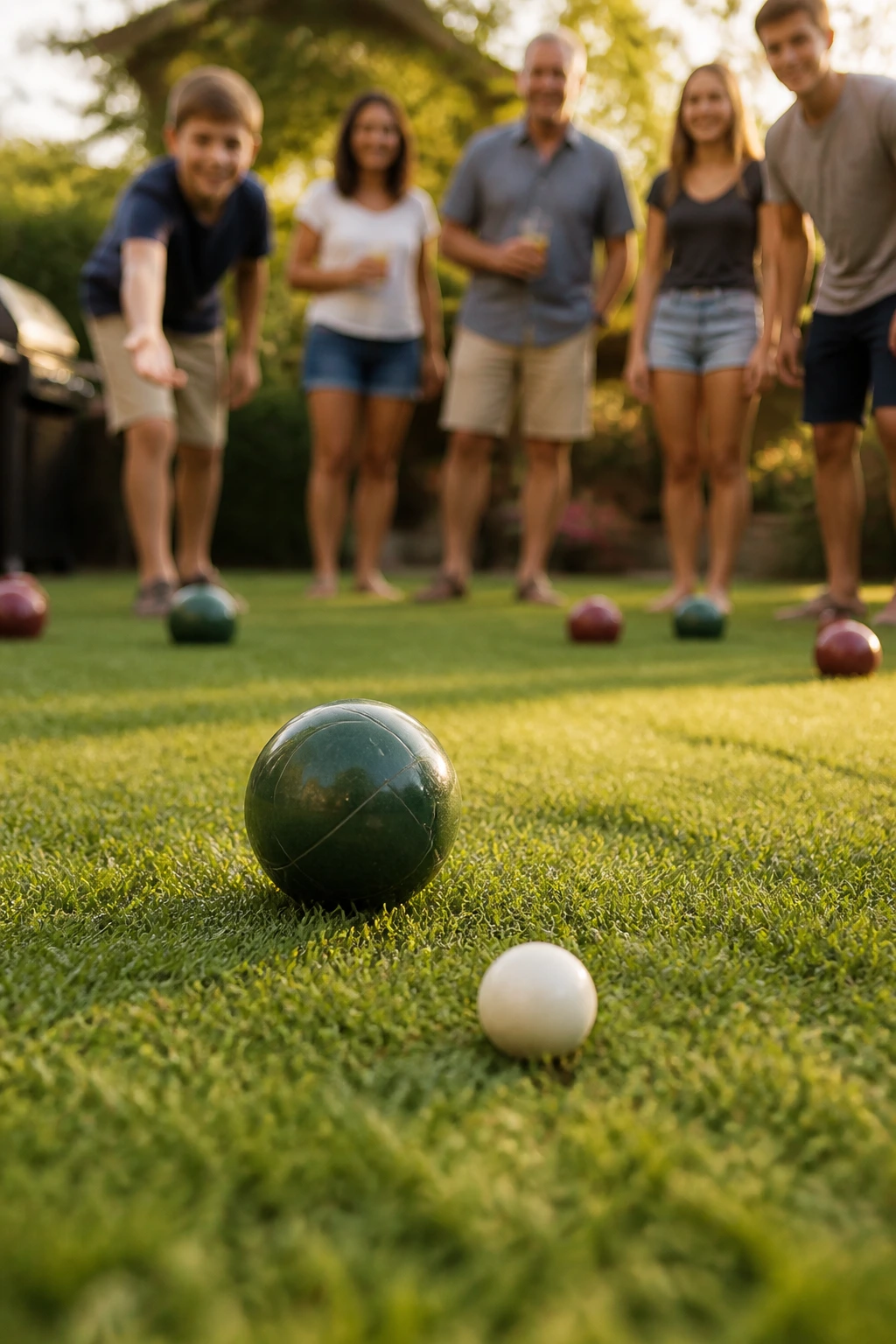
The best mixed-age cookout games are the ones that let everyone play the same round without pretending they have the same skill level. That’s the trick. You are not trying to flatten the ages. You’re trying to let the kid with sticky hands and the adult with a drink in one hand share the same setup without anybody feeling outmatched.
A simple way to do that is by changing the distance, not the game. Shorten the throwing line for younger players. Give kids a larger target. Let adults toss with their non-dominant hand if they want to make it interesting. Suddenly the game gets funny in a good way, not a humiliating way.
Games that handle mixed energy well
Bocce is one of my favorites for this exact reason. It looks calm. It is calm. But it still rewards touch, not brute force, which means a child can nudge a ball close to the marker and an adult can still lose the round because they got cocky on the last throw. The pace is relaxed enough that people can talk while they play.
Lawn dice is another good one because the scoring is visible and the turns are short. Giant foam dice or oversized wooden dice work well on flatter grass or a packed patio. If you want more heat in the game, assign mini-challenges to certain totals — but keep the dares harmless. No one wants to do burpees in a sunlit backyard while holding a paper plate.
Target toss games also travel well across ages. A set of foam balls tossed into hoops, buckets, or painted circles gives everyone a fair shot. The distance is adjustable, the rules are easy, and the misses are usually funny instead of messy. That matters. A lot.
Scavenger prompts can be sneaky good here too. Hide clues that are simple enough for kids to spot but still amusing for adults — a red spoon, a sunflower, the grill tongs, the blue chair by the fence. If you keep the clues grounded in the yard, people will not need a printed map or a referee.
The key is not to make the kids’ game feel separate. Give everyone the same game, then make the difficulty flexible. That keeps the energy shared instead of split into little age pockets around the yard.
The Heavy-Hitters: Cornhole, Bocce, Horseshoes, and Washer Toss
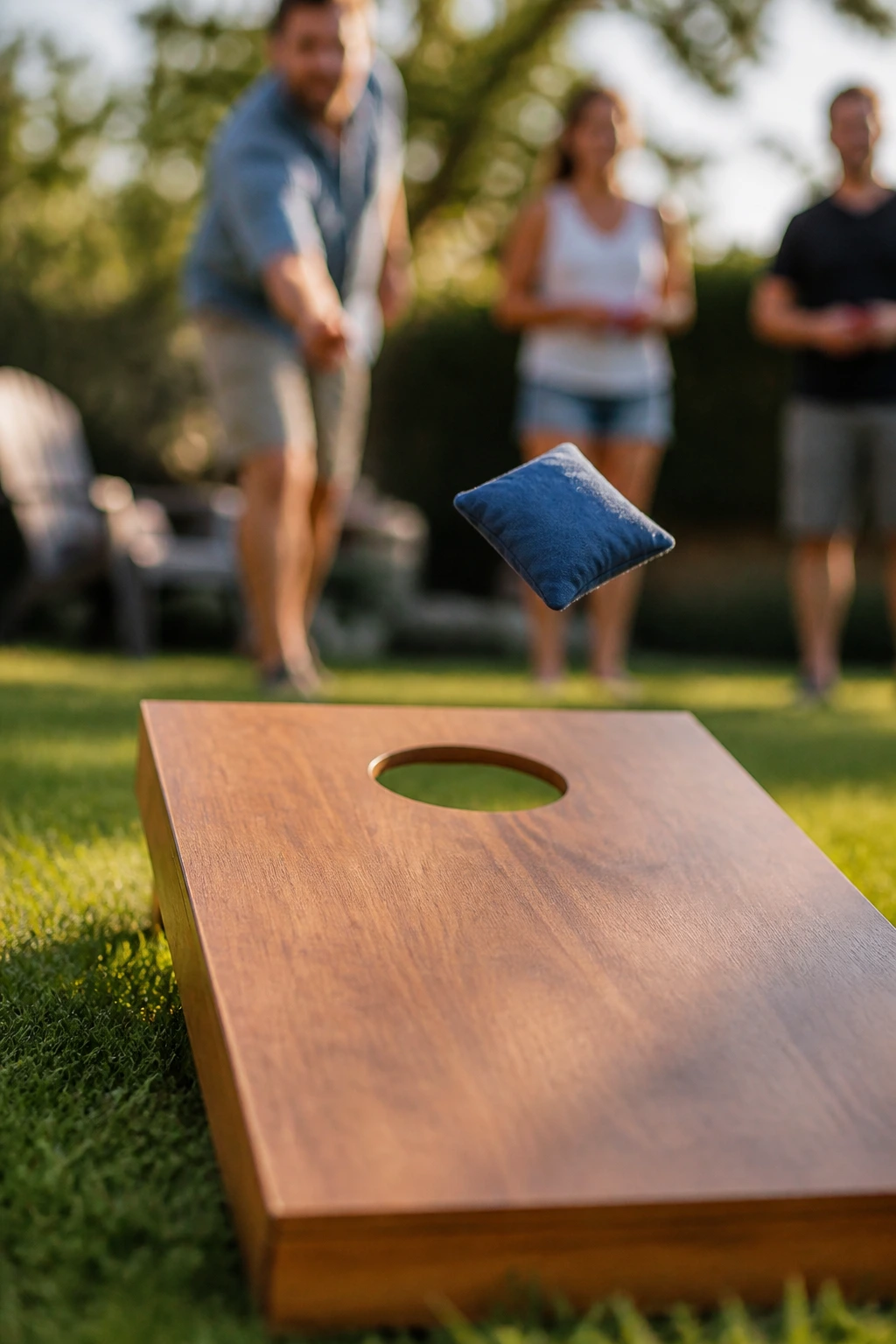
These are the classic cookout games for a reason. They give you enough competition to keep the loud people happy, but they do not demand a giant field or perfect fitness. They also have that lovely backyard rhythm where everyone plays, everyone heckles a little, and everyone suddenly develops a very strong opinion about form.
Cornhole: the easy crowd-pleaser with hidden skill
Cornhole is the game most likely to stay set up all afternoon. It needs only two boards, eight bags, and enough space to stand back. For a more official setup, the boards sit 27 feet apart, front edge to front edge. For a casual cookout, 21 feet is friendlier and usually better if your guests are not regular players.
The bags should feel firm but not rock-hard. I like them a little broken in, because stiff new bags bounce too much and make the first few rounds annoying. If you’re playing on grass, keep a small broom or rag nearby to brush off dirt and dampness. A wet bag changes its slide, and cornhole players notice that stuff immediately.
Bocce: the best game when you want motion without noise
Bocce has a gorgeous backyard temperament. It rolls instead of ricocheting. It rewards patience. It lets people stand around and argue politely about which ball is closer without looking ridiculous. That’s rare.
A decent bocce set should include a small marker ball — the pallino — and enough heavier balls to make the throws feel deliberate. If your yard is uneven, bocce can still work, but the slope becomes part of the strategy. That is not a flaw. It’s half the fun. The tricky part is setting the boundaries clearly so nobody argues about whether a ball rolled out by an inch or three feet.
Horseshoes: old-school, a little louder, still excellent
Horseshoes has a more old-porch feel to it. The classic game uses metal horseshoes and stakes, but for a cookout I often prefer a safer backyard version with rubber horseshoes, especially if kids are nearby or the throwing lane is close to a deck. Traditional stake spacing is far wider than most casual yards allow, so shortening the distance is normal. That is not cheating. That’s being realistic.
The main reason horseshoes still works is the satisfying arc of the throw. People love a game where you can see the whole shape of the effort. If the set is stable and the ground is not a minefield of roots, it becomes the kind of game that quietly absorbs half the afternoon.
Washer toss: simple gear, serious opinions
Washer toss is one of those games where the gear looks almost too simple to be worth it. Two boxes. A few washers. A distance of about 10 feet in casual play. Then someone starts keeping score, and suddenly the whole thing feels extremely important.
The beauty here is durability. Washers don’t care about light wind much. The boards are compact. The game sets up fast and stores even faster. It’s one of the easiest “serious” games to keep in a garage without it taking over the space.
If I had to pick one of these four for a mixed crowd, I’d still probably start with cornhole. But bocce is the one I’d trust most for a calm, long cookout where people want to play and keep talking at the same time.
Big-Lawn Games for Bigger Brags and Bigger Reactions
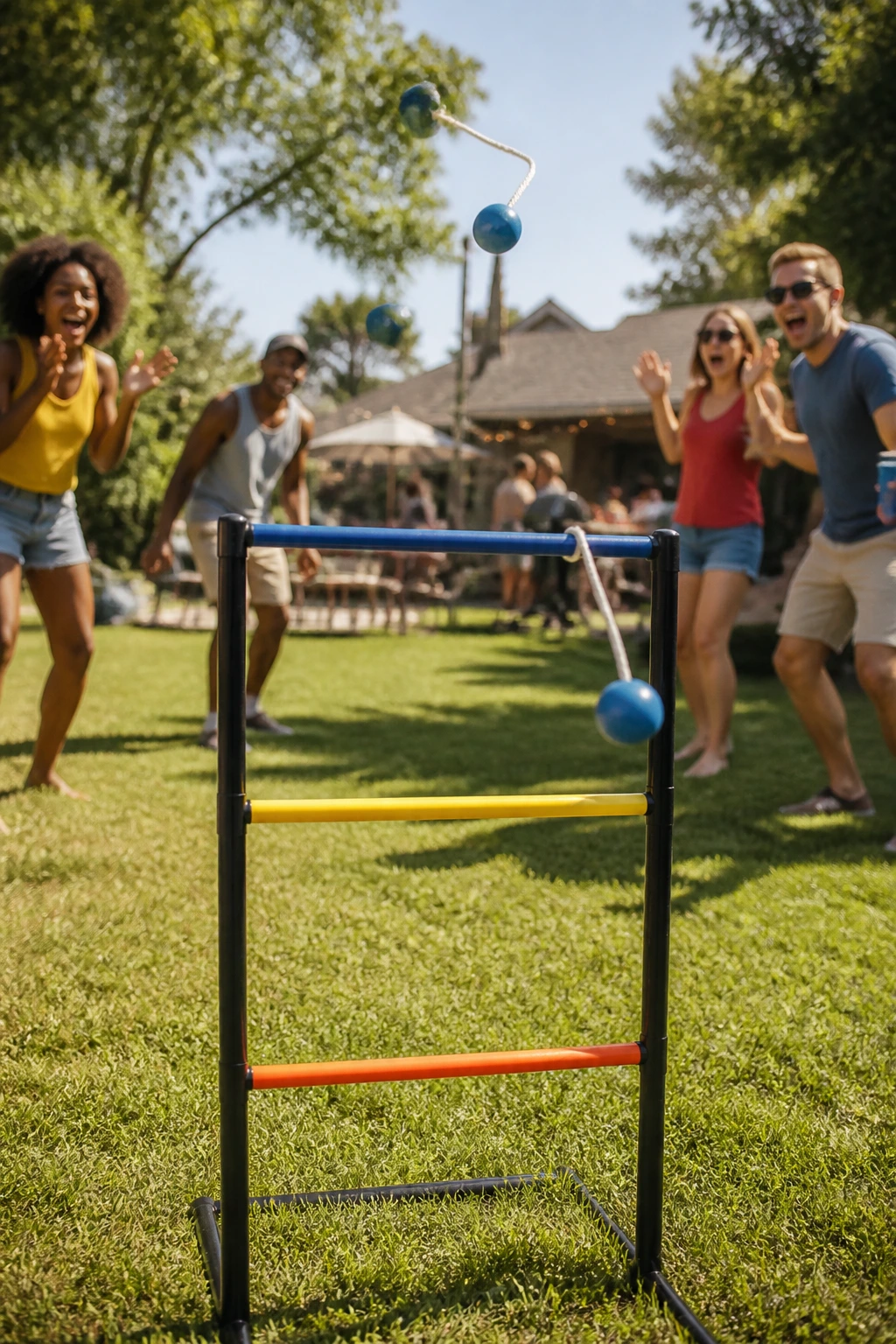
Some yards want a bigger game. Not because the people are more athletic — although a few guests will insist they are — but because the space is wide and the crowd has too much energy to sit still for long. If the cookout has room to breathe, use it.
A large lawn gives you permission to choose games with more movement and more laugh-out-loud moments. You just have to avoid the mistake of turning every game into a sprint. Backyard cookouts are not field days. Keep the rules loose enough that people can join late and leave early without ruining the fun.
Good picks when the lawn is wide open
Ladder toss works nicely because it has visible motion without a huge footprint. The soft bolas are easy to handle, and the scoring system is simple enough that guests can pick it up between bites. Set the ladders far enough apart to give the toss a real arc, but not so far that people start tossing like they’re feeding geese.
Kickball-style relay games bring out the loudest reactions. You do not need a full baseball diamond. A base path marked by cones or chairs is enough. Keep the teams small and the rounds short. The novelty is the fun; the endurance is not.
Frisbee target games are useful when you have a long stretch of grass and no one wants to hold a scoreboard. Put a bucket, a cone, or a laundry basket at different distances and let people toss from a marked line. A lightweight disc can drift in wind, so choose a firmer one if the yard is breezy.
Badminton sounds gentle until the volley starts going sideways, which is part of why I like it. It gives you movement without needing the whole yard. And if the net is set up once before guests arrive, it can serve as a quiet background game all afternoon.
There is a small but important rule here: if the game requires a running lane, keep that lane clear of chairs, drinks, coolers, and anything breakable. The wider the yard, the easier it is to get lazy about boundaries. That’s when ankles get twisted and cups get kicked over. Don’t do that to yourself.
Small-Space Games for Patios, Decks, and Side Yards
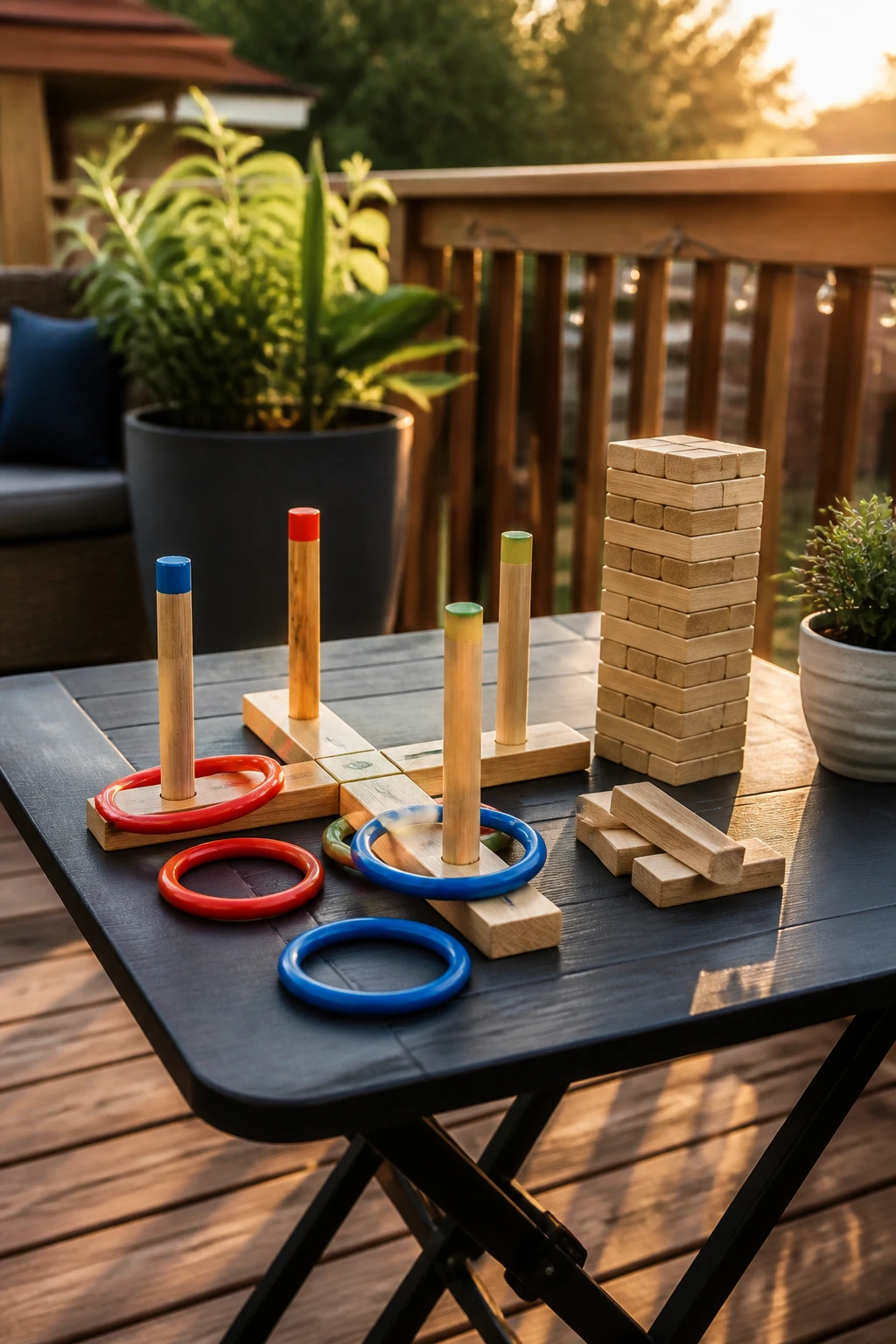
Not every cookout lives on a big lawn, and honestly, that’s fine. Some of the most pleasant backyard gatherings happen on small patios where everyone is close enough to hear each other without shouting. The trick is choosing games that fit the footprint instead of trying to force a backyard-size activity into a patio-sized space.
I like games that can live on a deck, a paved corner, or a narrow strip beside the fence. They need a small setup, soft pieces, and enough control that nobody sends equipment skittering into the grill. If the gear can be knocked over by one stray elbow, it does not belong here.
What actually works in tight quarters
Tabletop ring toss is a sleeper hit. Use a small stand, a bottle cluster, or even short cones placed on a side table. It keeps the action contained, and the guests can play while standing in place, which is useful when the food line is long.
Mini Jenga or a compact stacking game belongs on a patio because it gives the group something to watch without requiring a yard at all. Place it on a stable folding table, not a wobbly picnic bench. A small wobble turns the game into accidental chaos, and nobody needs that before dessert.
Card games are worth defending in a cookout article, even if they sound less flashy than lawn tosses. A deck of waterproof cards or a laminated set can carry a group for an hour, especially if the patio is crowded or the lawn is muddy. Rummy, spades, and simple matching games all work well when the table is already part of the cookout setup.
Yard dice can be adapted to small spaces by using soft foam dice and a short rolling lane. The sound is softer, the footprint is smaller, and you avoid the blast radius of heavy wooden cubes bouncing off a deck rail.
Small-space games are not a downgrade. They are a design choice. If your guests can step from the cooler to the game in three paces, you want games that respect that convenience instead of fighting it.
Quieter Games for People Who’d Rather Talk Than Sprint
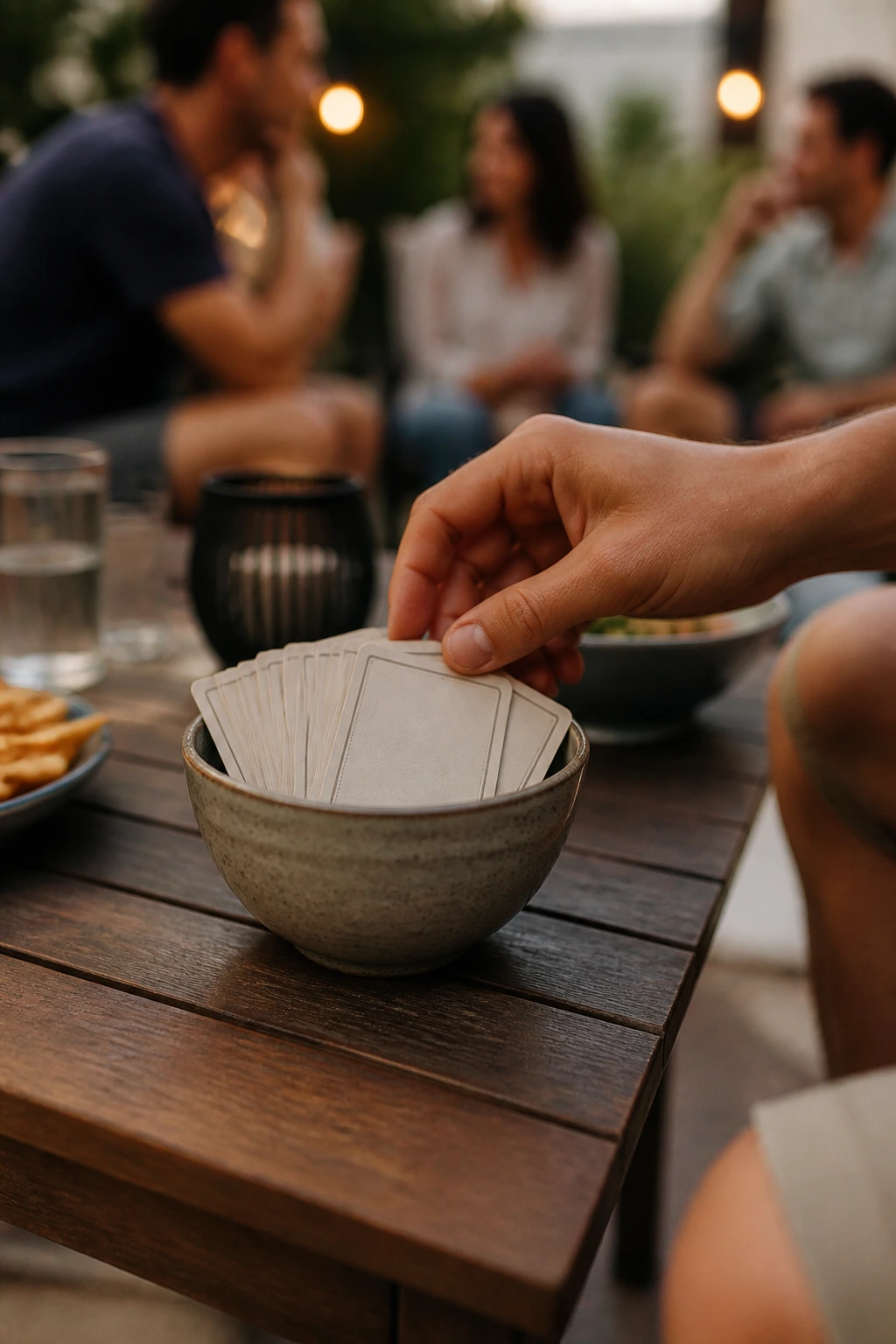
Not every good cookout game needs a throw, a net, or a boundary line. Sometimes the smartest move is to give people a game that lives mostly in the mind, or at least one that lets them stay seated with a drink and a plate. That matters more than hosts usually admit.
The quiet games keep the social mix smooth. They give the aunt who hates running around, the friend in nice sandals, and the neighbor who just wants to chat a place in the afternoon. If you skip this category entirely, you end up with a yard full of people watching other people play. That gets old fast.
My favorite calm options
Cookout bingo is almost too easy, which is why it works. Make a list of things that might happen during the afternoon — someone asks for more napkins, a child drops a hot dog bun, a dog checks every plate for treason, the grill lid opens five times in a row — and let guests mark them off. It makes everyone feel like they’re in on the joke.
Prompt cards are another easy win. Put a stack of conversation prompts in a bowl and let people draw one between bites. Keep them specific enough to be funny: “What food do you defend too hard?” lands better than “What’s your favorite memory?” because it belongs to the cookout setting.
Music trivia works if you have a portable speaker and a group that likes guessing. Keep the clips short. Ten seconds is enough. The game gets better when people can hear the chorus and think they know the answer before they actually do.
Two-truths-and-a-lie sounds old, and it is, but it still plays well outside because the format is simple. No props, no setup, no chasing. Just a few people with stories and one person trying to bluff without laughing.
These games are not filler. They are the glue. They keep the gathering from feeling like a string of separate mini-events. And when the burgers are resting, that glue matters.
Heat, Wind, and Uneven Grass: Picking the Right Game for the Weather
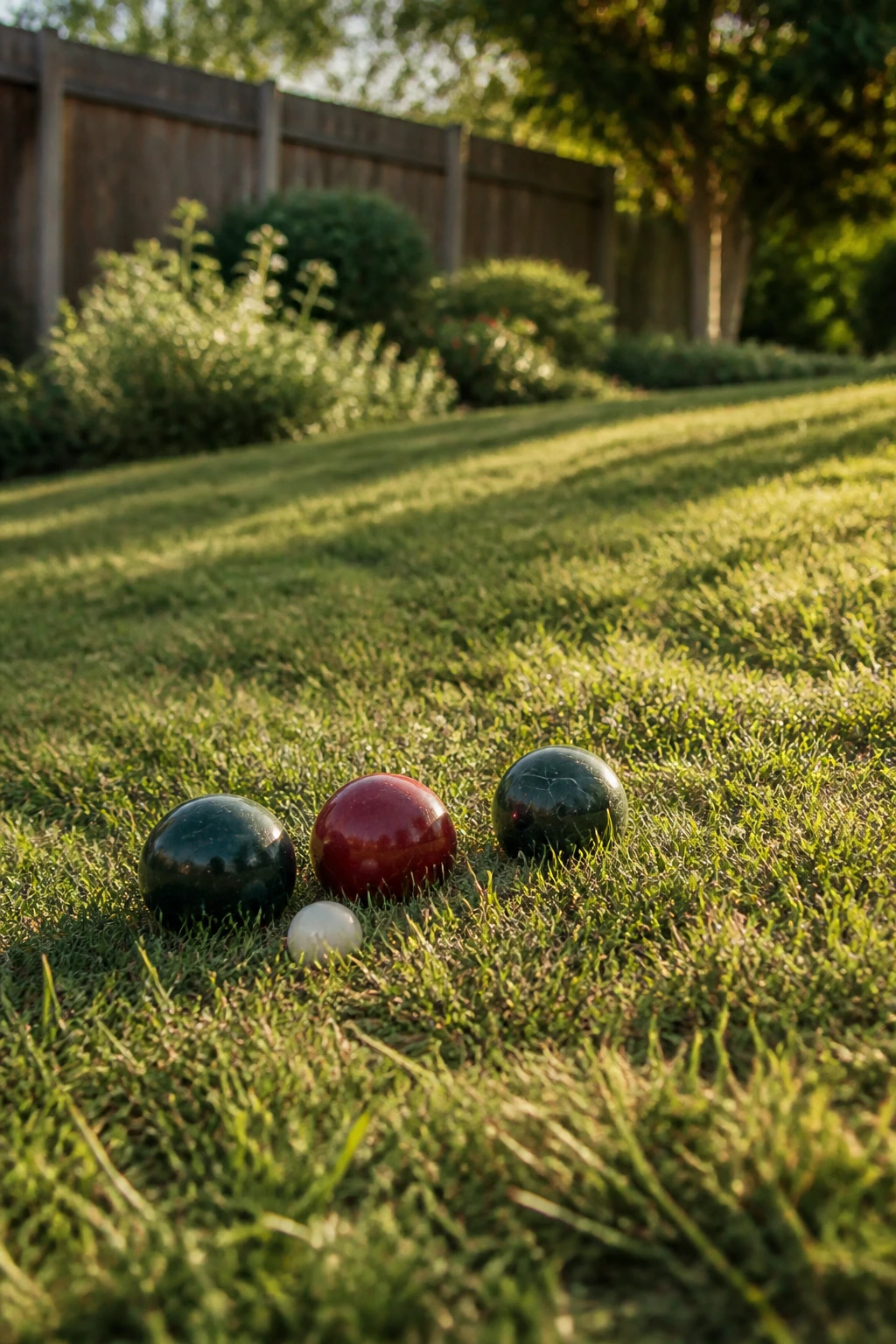
Weather changes the game more than people expect. A breezy yard punishes lightweight targets. Uneven grass makes rolling games weird. Heat drains patience, which is exactly when overly complicated rules start sounding like a bad idea. If you choose the wrong game for the conditions, even a good group will look strangely unenthusiastic.
When the ground slopes
Pick games that forgive angle. Bocce handles slope better than most people think, and cornhole can still work if the boards are stable. I’d avoid games that rely on perfectly level placement unless you’re willing to spend ten minutes shimming boards with scraps of cardboard or folded paperboard. That’s the kind of tiny frustration that ruins a nice afternoon.
When the wind picks up
Wind is the enemy of foam rings, paper targets, lightweight cups, and anything that stands tall and skinny. Lower-profile games work better. Heavier beanbags, bocce balls, and washers stay put more reliably. If the game needs a basket, weigh the base down. A bowl of napkins is not enough. A real weight matters.
When the heat gets brutal
Short rounds save the day. So does shade. Put the game under a tree, beside a canopy, or near a building edge where guests can duck out after a turn. Fast games with limited standing time — like washer toss or one-round cornhole ladders — make sense here. Long, running games are fine for cooler weather, but in heat they turn people sloppy and cranky.
When bugs show up
Keep the setup close to the house if the bug pressure is bad, and choose games that don’t require everyone to stand still in one spot for too long. A quick moving game reduces the amount of time people spend getting annoyed by mosquitoes. It also gives them a reason to keep moving between the grill, the food, and the seats.
Weather never ruins a cookout game by itself. The bad pairing does. Choose the game that fits the day instead of insisting the day fit the game.
How to Keep the Energy Up Without Turning the Cookout Into a Tournament
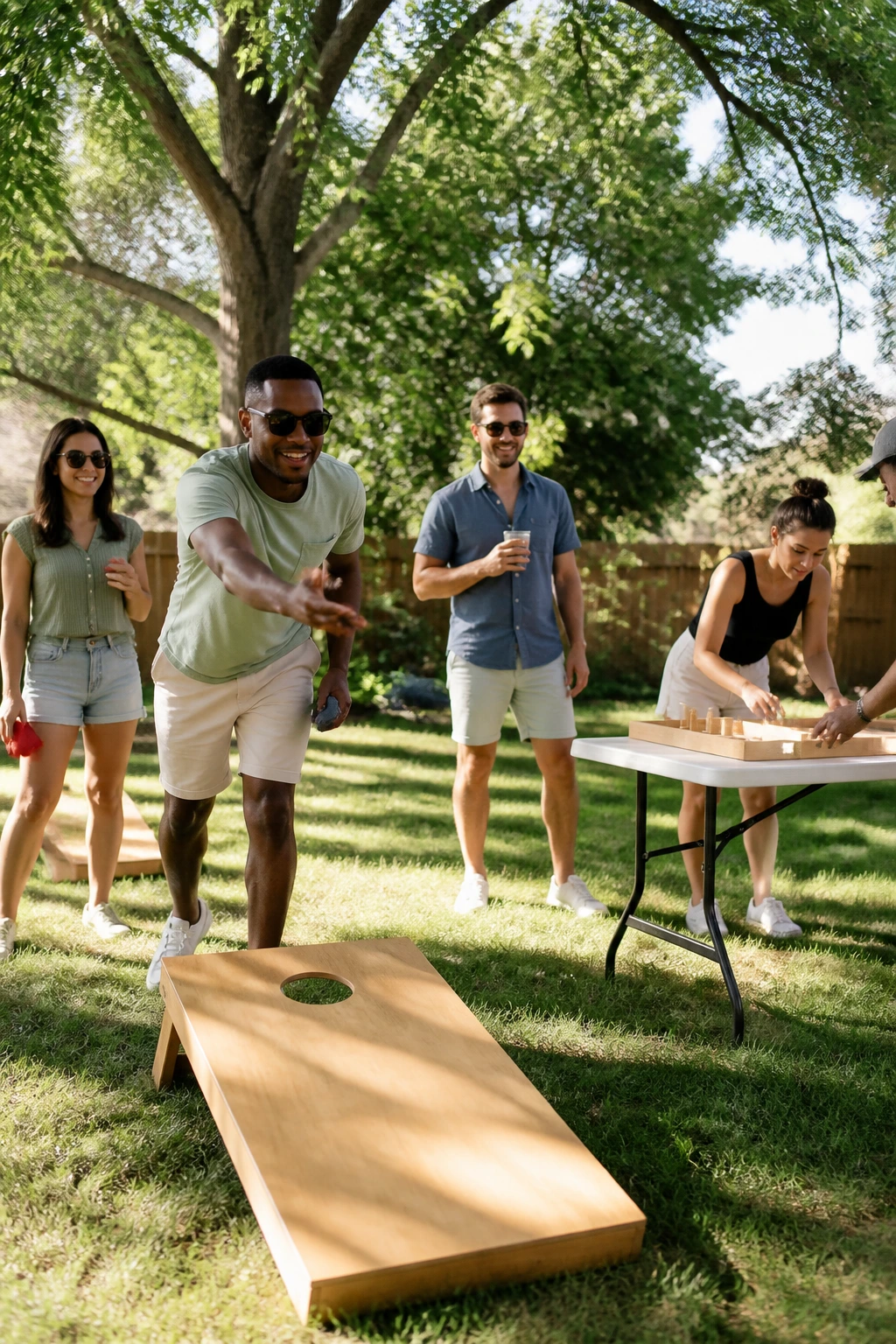
A cookout game should add rhythm, not chaos. If the rounds drag, people wander off. If the competition gets too serious, the whole yard starts sounding like a sports bar with folding chairs. The sweet spot is somewhere in the middle: enough structure to keep people engaged, not so much that the game swallows the party.
I prefer short rounds with rotating players. Four throws, one quick score, next pair steps in. Or a single game to 21 with no long bracket. The point is momentum. You want a line that moves without feeling like a line.
A scoreboard helps, but only if it stays simple. Chalk on a fence post, a piece of masking tape on the side of a cooler, or a notepad on the folding table is enough. Fancy boards are nice if you already own one. Otherwise, they’re a distraction. I’ve watched adults spend more time arguing about scoreboard format than they spent throwing bags. Ridiculous.
Another thing: don’t let one game hog the whole afternoon. If cornhole is the anchor, that’s fine. But have a second, quieter option nearby so people who are done competing can drift away without leaving the scene entirely. That keeps the event from splitting into hard factions: the players, the spectators, and the people hiding inside by the sink.
And pace the games around the food, not the other way around. A round before the grill gets going. Another after the first plates go out. Maybe one more after dessert if the crowd still has legs. That rhythm feels natural. It also leaves space for actual conversation, which is the part people remember later.
Practical Ways to Make the Games Better
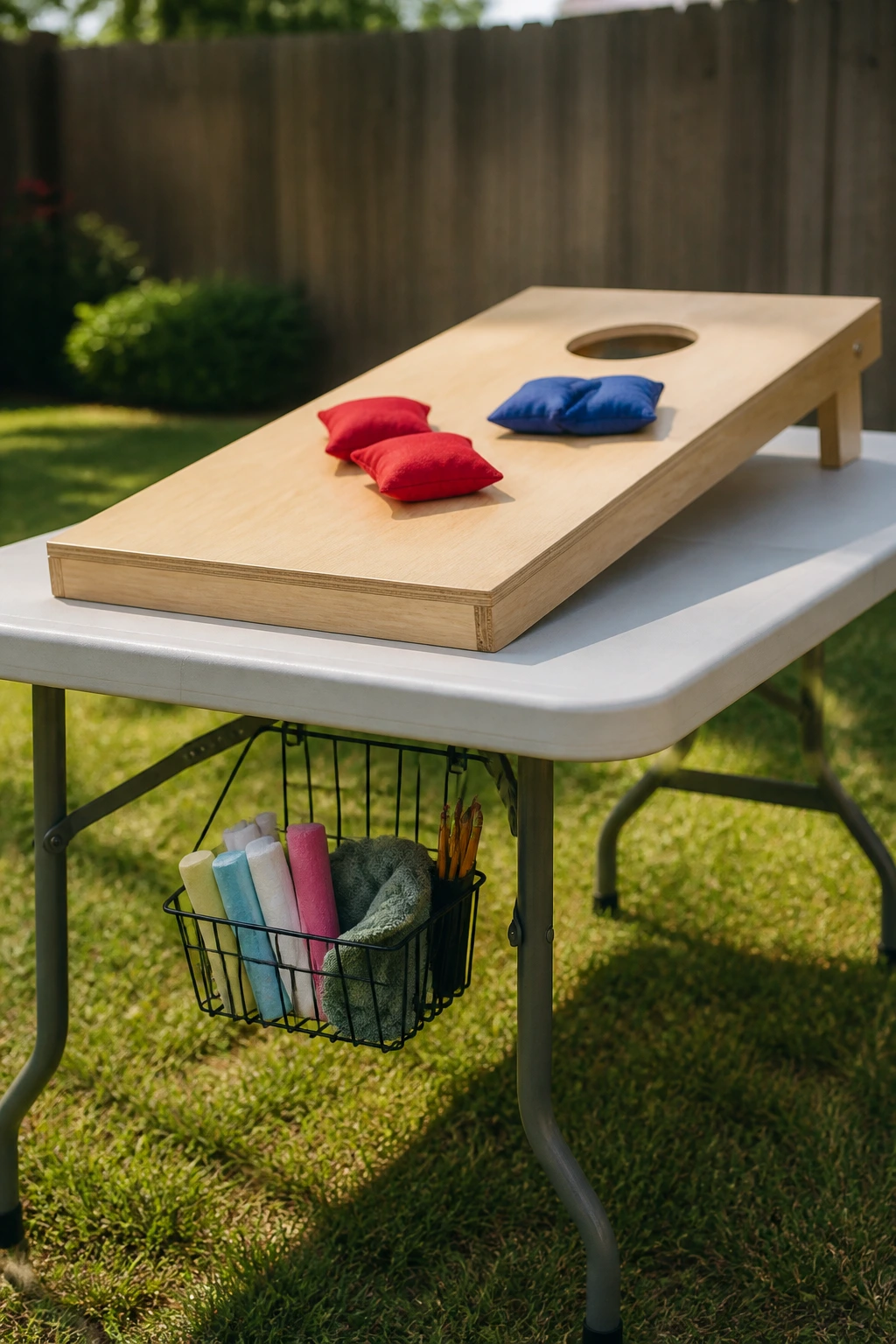
A few small choices make backyard cookout games feel polished without making them fussy. And thank goodness for that, because nobody wants to haul a suitcase of “event supplies” into the yard just to play ring toss.
Start with one anchor game. One good setup beats three mediocre ones. If cornhole or bocce is the main draw, let it carry the energy and keep the rest of the yard uncluttered.
Give the first round away. I mean that literally. Let the opening game be casual and low-stakes. People relax faster when they know the first toss does not matter much.
Keep a cleanup basket nearby. Toss it under the table with chalk, spare pencils, a rag, a deck of cards, and the score sheet. When something disappears, the basket saves you.
Use two difficulty levels. A short line for kids or beginners, a longer line for anyone who wants the challenge. That tiny adjustment keeps more people in the game longer.
Choose gear you can wipe down. Grass, sauce, and sunscreen all end up on outdoor equipment. Soft bags, plastic targets, and washable scorecards are less annoying than gear that stains if you breathe on it.
Have a fallback game with no moving parts. If the wind, heat, or crowd energy changes, a seated game gives you a graceful exit. You will use it more often than you think.
The host’s job is not to orchestrate a perfect competition. It’s to keep the yard from feeling lopsided. Small adjustments do that better than big speeches ever will.
The Backyard Mistakes That Kill the Mood Fast
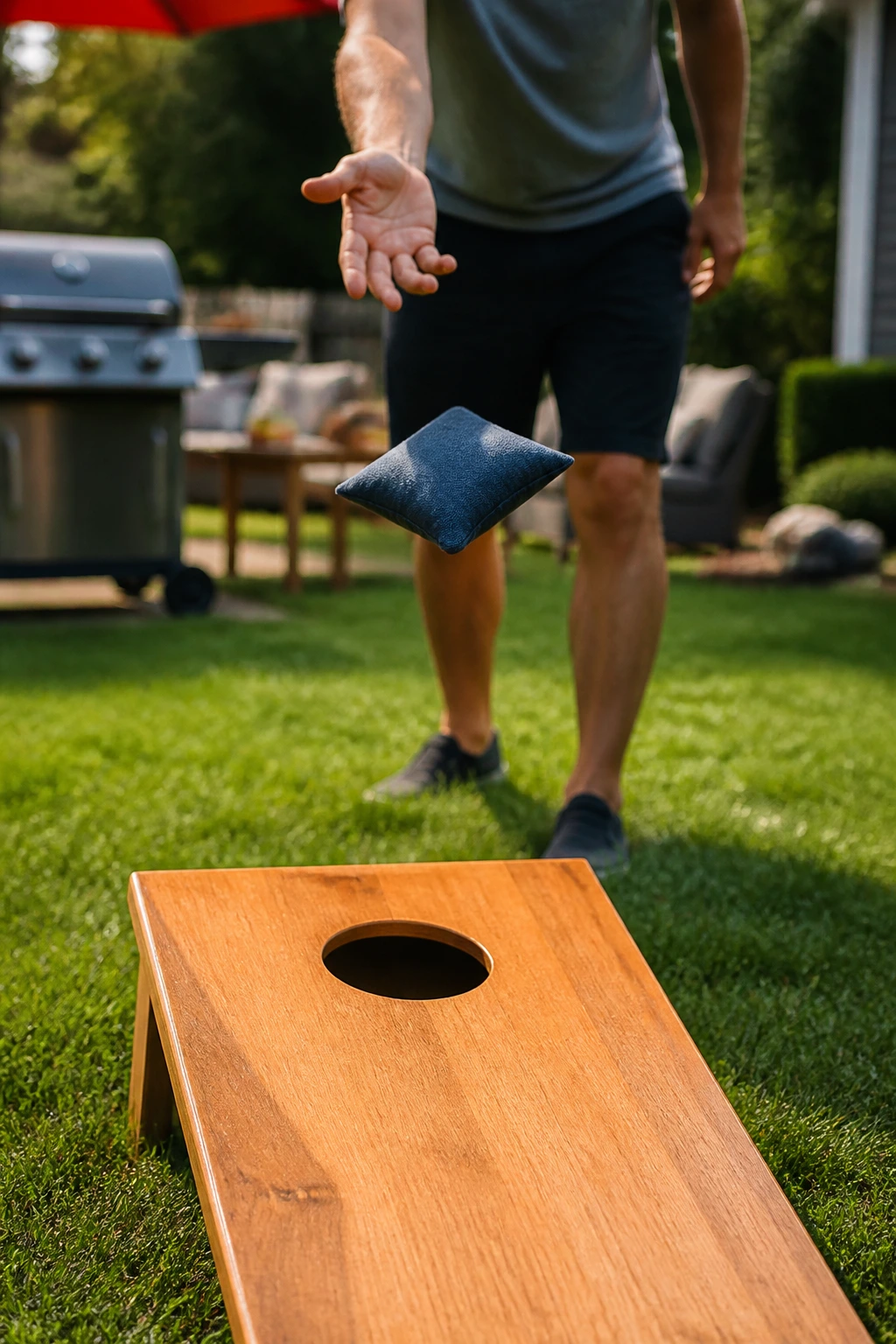
The fastest way to ruin a cookout game is to make it feel like homework. That happens more easily than people admit. Somebody over-explains the rules. Somebody else sets up the game in a traffic lane. Then half the group decides they’d rather stand near the chips.
-
Too much setup for the first round. If guests arrive and the game still needs assembly, you lose momentum before it starts. The fix is simple: pre-stage the boards, balls, scorecards, or buckets before people walk through the gate.
-
Putting the game where everyone needs to walk. A cornhole board beside the serving table becomes an obstacle, not entertainment. Move the game to the edge of the yard or create a clear lane around it.
-
Choosing equipment that doesn’t fit the surface. Lightweight targets on windy grass. Heavy rolling balls on rough gravel. Tall stackers on a deck that shakes. Match the gear to the ground, or prepare for irritation.
-
Letting one group monopolize the game. Some people can turn a backyard toss into a private championship. Set a rotation rule, or the rest of the guests will drift away and quietly resent it.
-
Ignoring shade and seating. Standing in direct sun for 25 minutes changes everybody’s mood. Put chairs nearby. Add shade if you have it. People play better when they can sit down between turns.
-
Making the rules bigger than the fun. If a guest asks for a clarification and the explanation turns into a five-minute lecture, the game has drifted too far toward bureaucracy. Keep it loose enough that a stranger can jump in without embarrassment.
These mistakes are small. That’s why they matter. Backyard games rarely fail in a dramatic way. They just get a little annoying, then a little more annoying, and suddenly everyone is pretending not to care.
Variations for Different Crowds and Yard Sizes
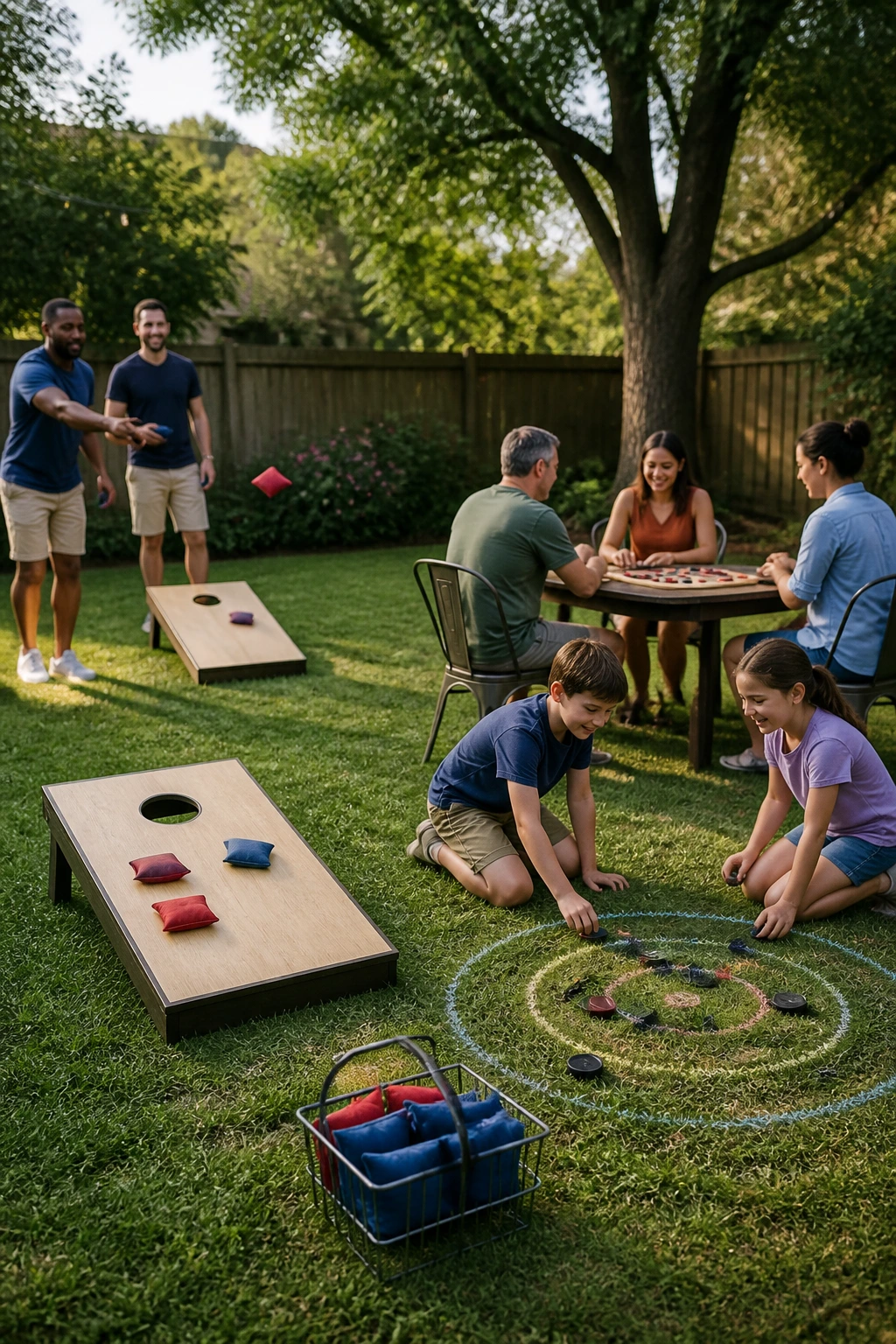
The nicest thing about cookout games is how easily they can be reshaped. You do not need one perfect setup. You need a version that fits the crowd that actually showed up. That crowd may be rowdy, sleepy, child-heavy, older, tiny, or unexpectedly competitive. Pick accordingly.
The First-Visit Friendly Setup
One easy toss game. One seated game. That’s it. This version is for mixed guests who don’t know each other well yet. The goal is to keep everyone included without forcing the extroverts to do all the work.
The Rivalry Lane
This is the setup for cousins, neighbors, and siblings who want to keep score with a little too much enthusiasm. Put out cornhole, washer toss, or horseshoes, then give the winner a tiny prize — first pick of dessert, bragging rights, or the right to choose the music for the next round. Keep it playful. No one needs a feud over backyard leisure.
The Family Scatter
Kids get a chalk target zone, adults get bocce or rings, and the table gets a calm game like cards or trivia. This version keeps every age group busy without separating the yard into hard little islands.
The Narrow-Patio Edition
Use tabletop ring toss, cards, mini stacking games, and prompt cards. The key here is low movement and soft gear. If the deck is small, do not force a big-lawn game onto it. The patio will win that argument.
The Big-Lawn Showcase
Bocce, ladder toss, relay games, frisbee targets, and a long chalk lane all make sense when the yard has room. This version is more active, but it still needs short rounds and an easy reset. A big lawn is not a reason to complicate things. It’s a reason to spread out a little.
These variations all do the same job: they respect the shape of the party. That’s the part hosts often miss. The best game plan is the one that fits the people who are actually there.
The Gear That Earns Its Spot in a Cookout Bin
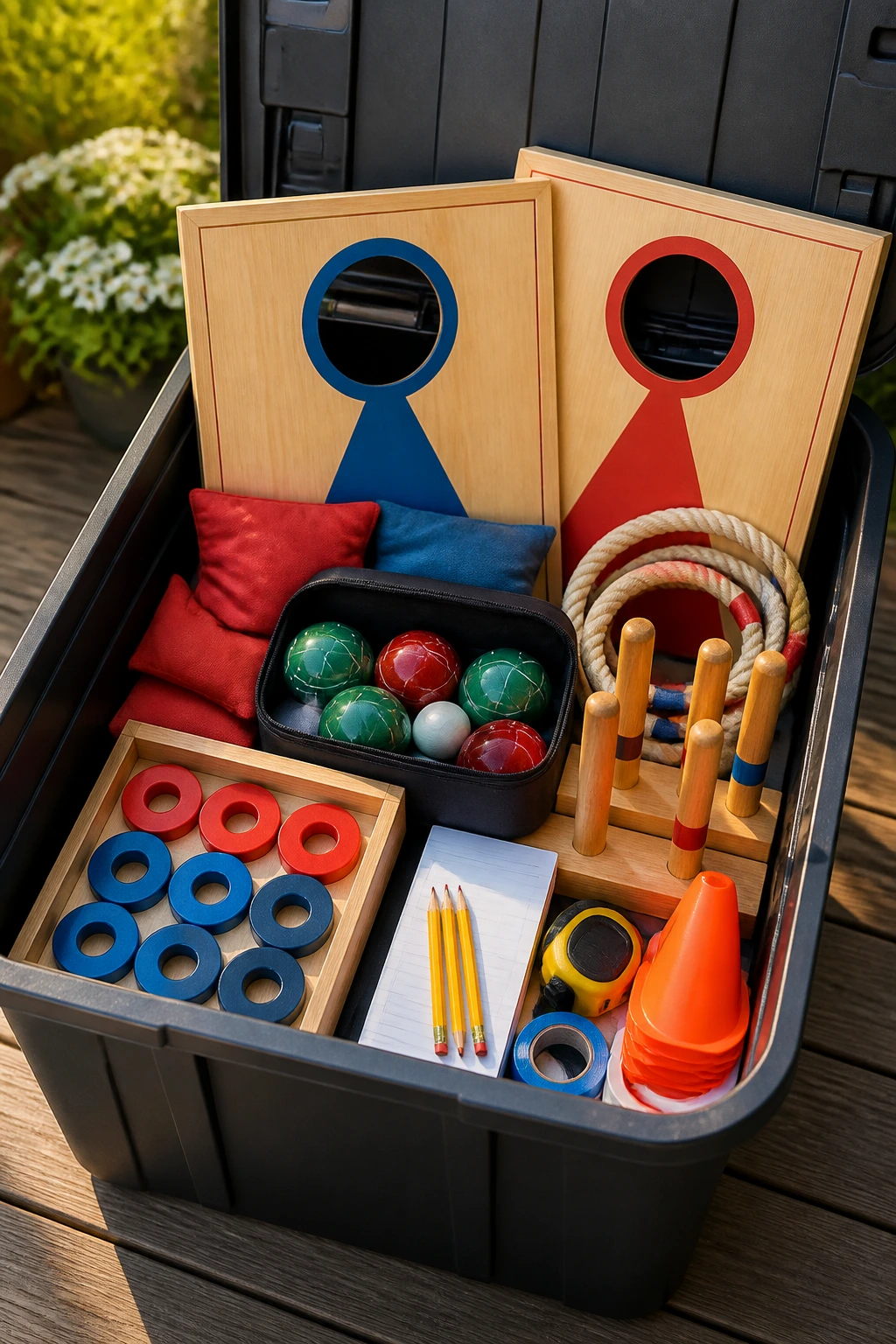
If you want the games to come out smoothly every time, build a small bin and keep it ready. I like gear that survives heat, grass, damp hands, and the occasional drop on the patio.
-
Cornhole boards and bags — The classic anchor game. Look for boards that store flat or separate cleanly, and keep the bags in a dry pouch when not in use.
-
Bocce set — Good for calm play and mixed ages. A compact set is easier to store than people expect.
-
Washer toss boards and washers — Small footprint, quick setup, easy to keep in a garage or shed.
-
Soft ring toss set — Choose rings or toss pieces that won’t damage deck boards or bounce too far on grass.
-
Measuring tape — Useful for setting distances instead of guessing. Guessing leads to arguments. Arguments lead to long explanations nobody asked for.
-
Chalk or removable marking tape — Great for boundaries, scoring lines, and kid-friendly target zones.
-
Cones or small markers — Flexible, cheap, and easy to move as the yard changes.
-
Scorecards and pencils — Old-fashioned, yes. Still the easiest way to keep a game moving without everyone checking a phone.
-
Folding table — Handy for cards, prompt games, and storing drinks off the playing zone.
-
Mesh bag or tote — Keeps small pieces from vanishing into the garage abyss.
-
Microfiber cloth and a small brush — Useful for wiping off grass clippings, dust, sauce drips, and wet spots before gear gets stored.
-
A basic storage bin with a lid — Not glamorous. Extremely useful. Dry, stackable, and better than scattering game pieces into three different cabinets.
A good cookout bin saves time and memory. If it can be grabbed in one trip, it gets used more.
Keeping Boards, Balls, and Bags Ready for the Next Cookout
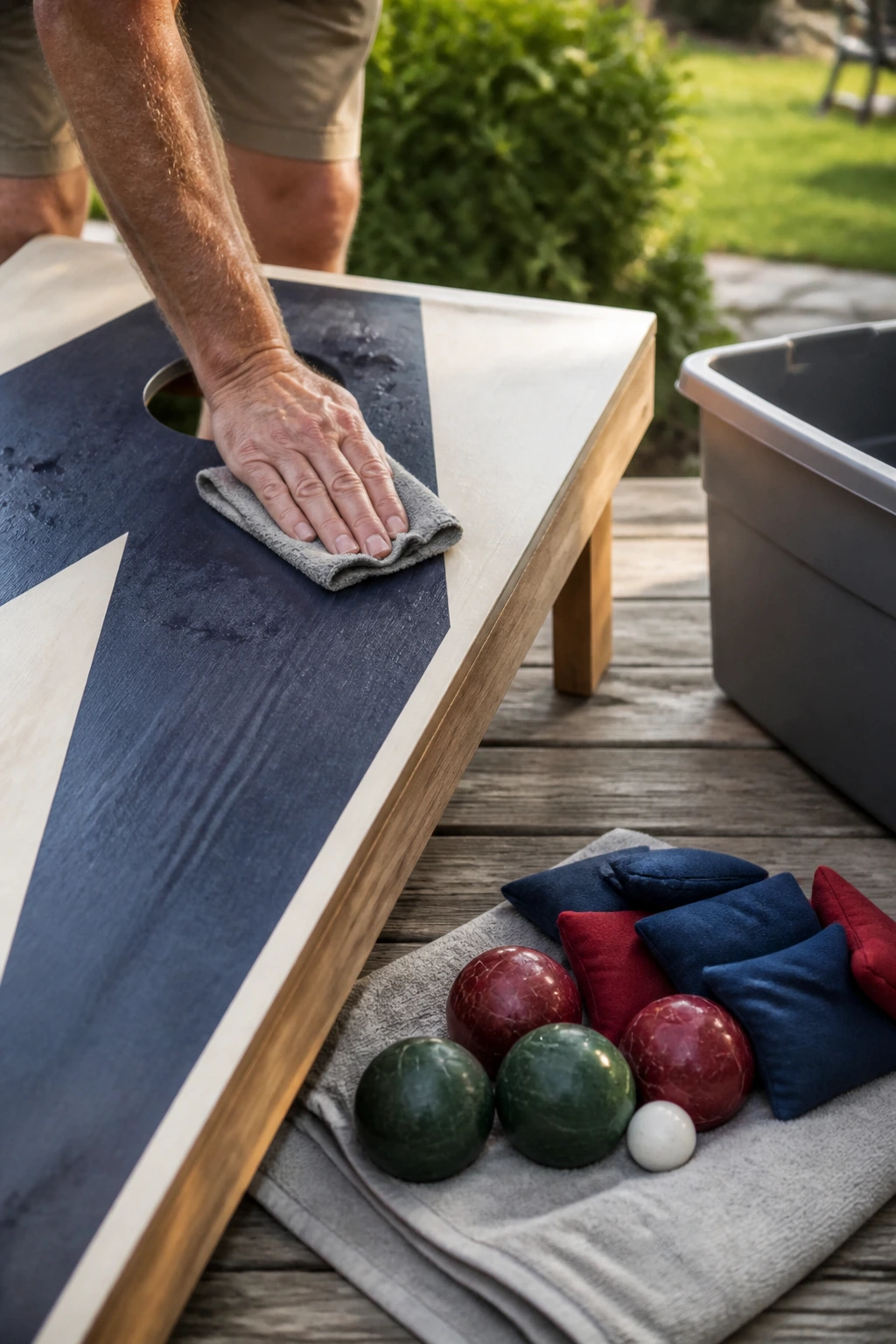
Outdoor gear ages badly when it’s left wet, dusty, or half-packed. The fix is dull, but it works. Clean the gear after the cookout while the mess is still easy to remove, then store it somewhere dry and out of the sun.
After each use, I’d wipe cornhole boards, ring toss pieces, and washer boards with a slightly damp cloth. If the bags picked up damp grass, spread them out for an hour before packing them away. Wet fabric tucked into a bin is how you get mildew, and mildew smells like a garage that lost a fight with a swamp.
Once a month — or after a few heavy uses — check the hardware. Look for loose screws on boards, bent stakes, cracked plastic, or frayed seams on bags. A quick repair now is cheaper than replacing the whole set later. If you use wooden boards outdoors, reseal them when water stops beading on the surface. That’s a simple clue the finish is getting tired.
Cards, pencils, chalk, and score sheets deserve their own little pouch. Keep them together. If you wait until the next cookout to find the pencil, you’ll end up borrowing a random pen that barely works and leaves a gray line across the scorecard.
Store everything indoors if you can. A garage is fine if it stays dry. A shed is fine if it doesn’t bake in direct sun all day. What you want to avoid is long stretches of heat and moisture. They warp wood, fade markings, and make even sturdy gear feel old before its time.
Frequently Asked Questions
What is the best backyard cookout game if I only want to set up one thing?
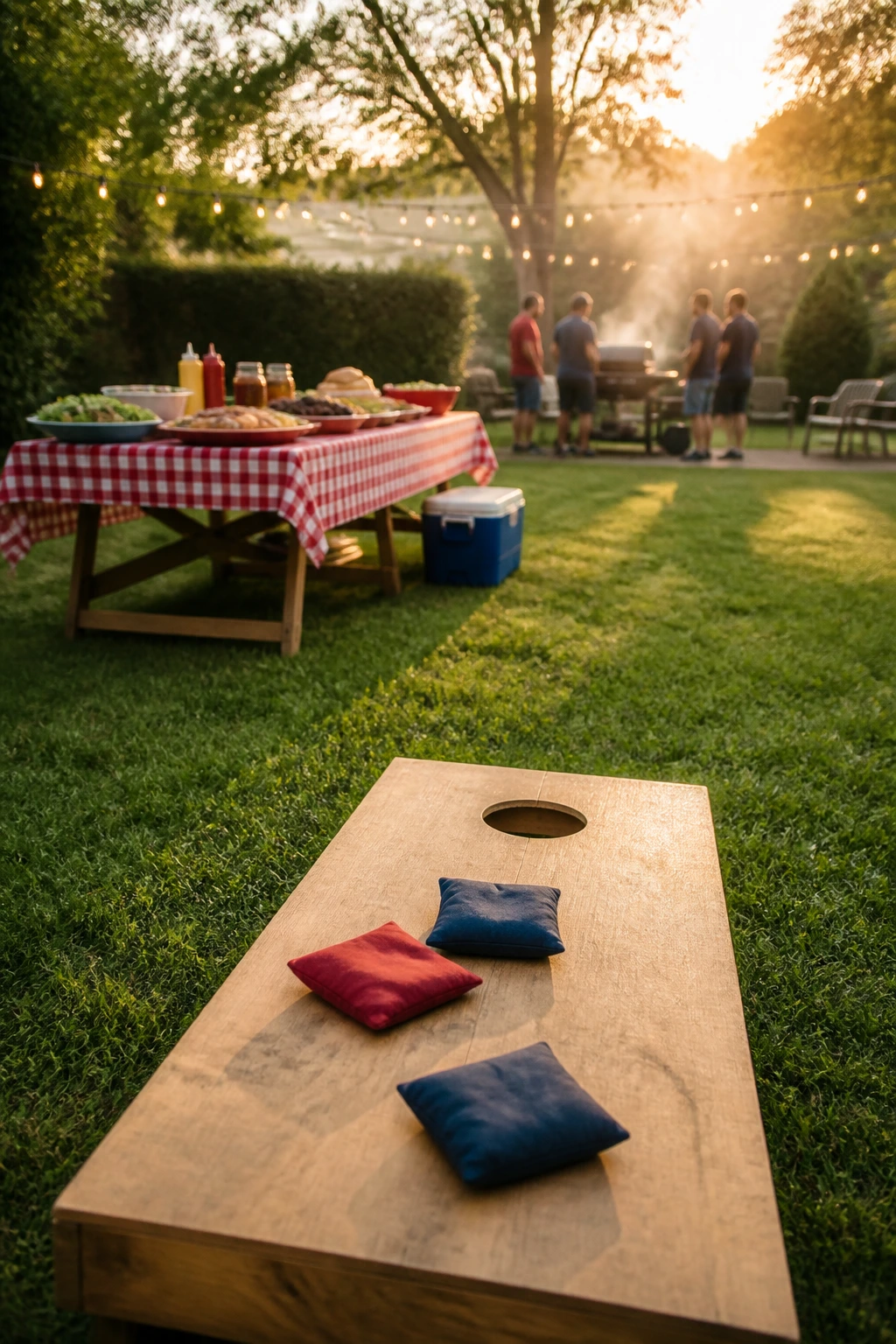
Cornhole is the safest bet because it’s fast to explain, easy to see from across the yard, and simple to rotate between groups. If your crowd is calmer or older, bocce might be the better pick because it keeps the pace slow and conversational.
How far apart should cornhole boards be for a casual cookout?
For a friendly backyard game, 21 feet front edge to front edge is a comfortable distance for most adults. If the players are experienced, you can move to the standard 27 feet, but that usually feels a little stiff for mixed groups.
What game works best when the yard is sloped?
Bocce handles slope better than most games because the roll becomes part of the challenge. Cornhole can also work if the boards are stable, but games that rely on perfect balance or precise stacking tend to get frustrating on an uneven lawn.
Can I run cookout games on a patio instead of grass?
Yes, as long as you choose gear that won’t scratch the surface or bounce too far. Tabletop ring toss, cards, mini stacking games, and soft-target games all work well on a patio or deck. Skip anything with hard throws unless you have plenty of clearance.
How do I keep kids from taking over the main game?
Give them a parallel version with shorter distances or easier targets. Kids play better when they feel included, and adults play better when they are not constantly worrying about safety. Two versions of the same game usually work better than one version with constant shooing.
What should I do if the wind keeps ruining the game?
Choose lower, heavier equipment. Bags, bocce balls, washers, and weighted targets stay put better than tall cups, lightweight rings, or paper games. If the wind is bad enough, switch to a seated game and stop fighting the yard.
How many games should I set out at once?
Two is usually plenty: one active game and one calm option. More than that, and the yard starts to feel crowded and unplanned. The exception is a very large gathering with clear zones and plenty of space between them.
How do I keep the games from getting too competitive?
Set a round limit, not a marathon. Short games to a modest score keep the mood lighter, and a casual rotation rule prevents one group from dominating the board. If somebody gets too serious, move them to the more competitive game and let the rest of the crowd keep chatting.
The Last Round
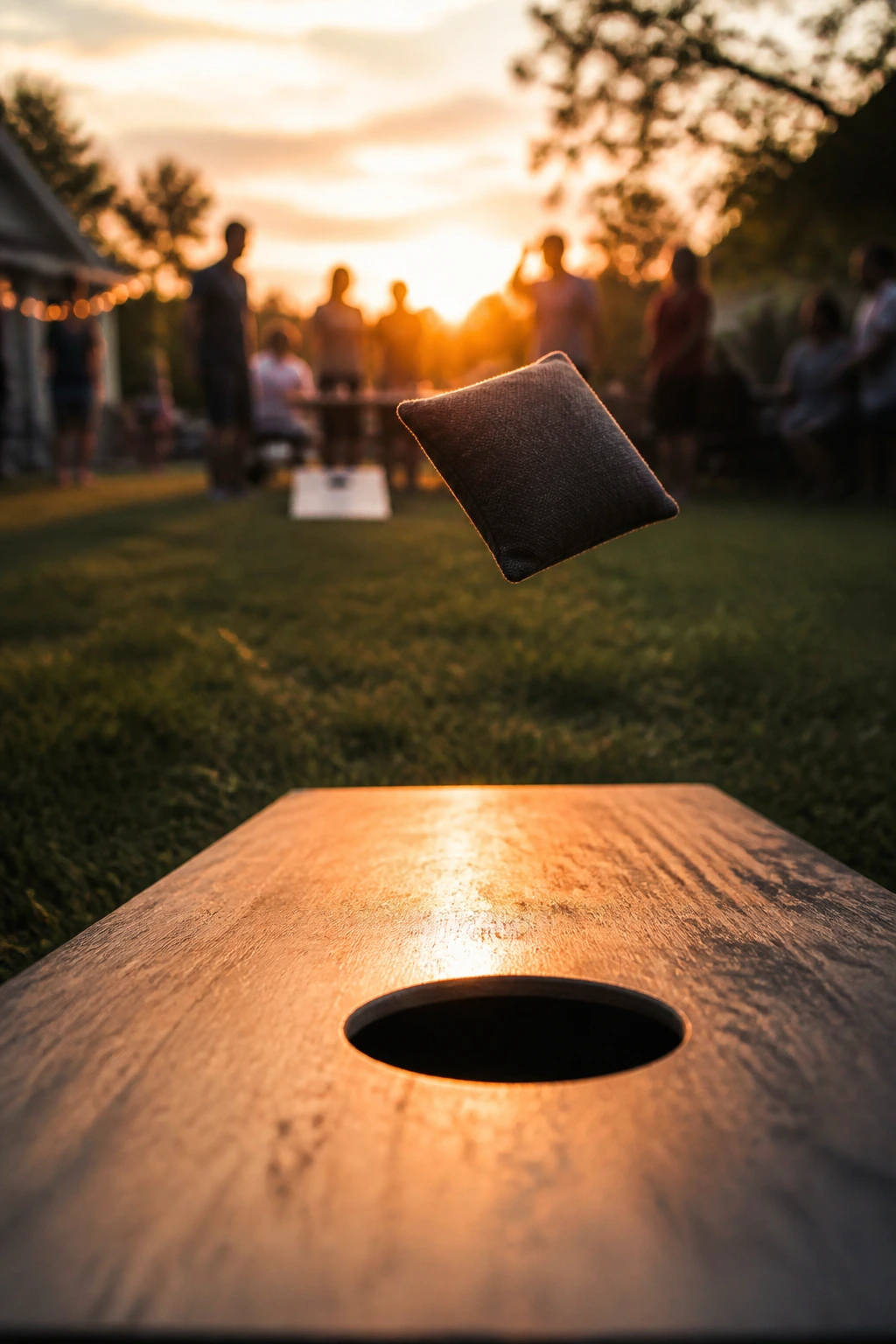
The best cookout games are the ones that feel like they belong beside the smoke, not above it. They don’t demand perfect weather, perfect grass, or a perfect mood. They just give people something to do while the food cooks, the plates circulate, and the evening settles into that easy, talky rhythm that makes backyard gatherings worth the trouble.
I still think the smartest move is the simplest one: choose one game that gets people moving, one that lets people sit, and one that can survive a little chaos. That mix handles almost every backyard I’ve ever seen. And the best part is how little it asks from the host once it’s set.
Next time the grill starts hissing and the first guests drift toward the yard, put a game out before the burgers come off. The rest tends to take care of itself.