



Garlicky stuffed veggies work best when the vegetables are treated like dinner, not a garnish. You want the zucchini to stay upright, the peppers to soften at the edges, and the mushrooms to release just enough juice to perfume the filling instead of drowning it. When that balance lands, the whole tray smells like garlic, olive oil, and roasted tomatoes before you even pull it from the oven.
I like this kind of meal because it solves the annoying part of vegetarian cooking: making the plate feel finished. Chickpeas, quinoa, feta, and Parmesan give the filling enough backbone that you’re not hunting for bread an hour later. The garlic matters here, too — six cloves cooked with onion and tomato paste turn mellow and sweet, not sharp.
The method is straightforward, but a few small habits make it work better: par-roasting the shells, cooking off the moisture in the skillet, and stuffing the vegetables with a filling that holds together when you press it with a spoon. Get those pieces right and the tray comes out browned around the edges, fragrant in the middle, and sturdy enough to serve without drama.
Why You’ll Love This Recipe
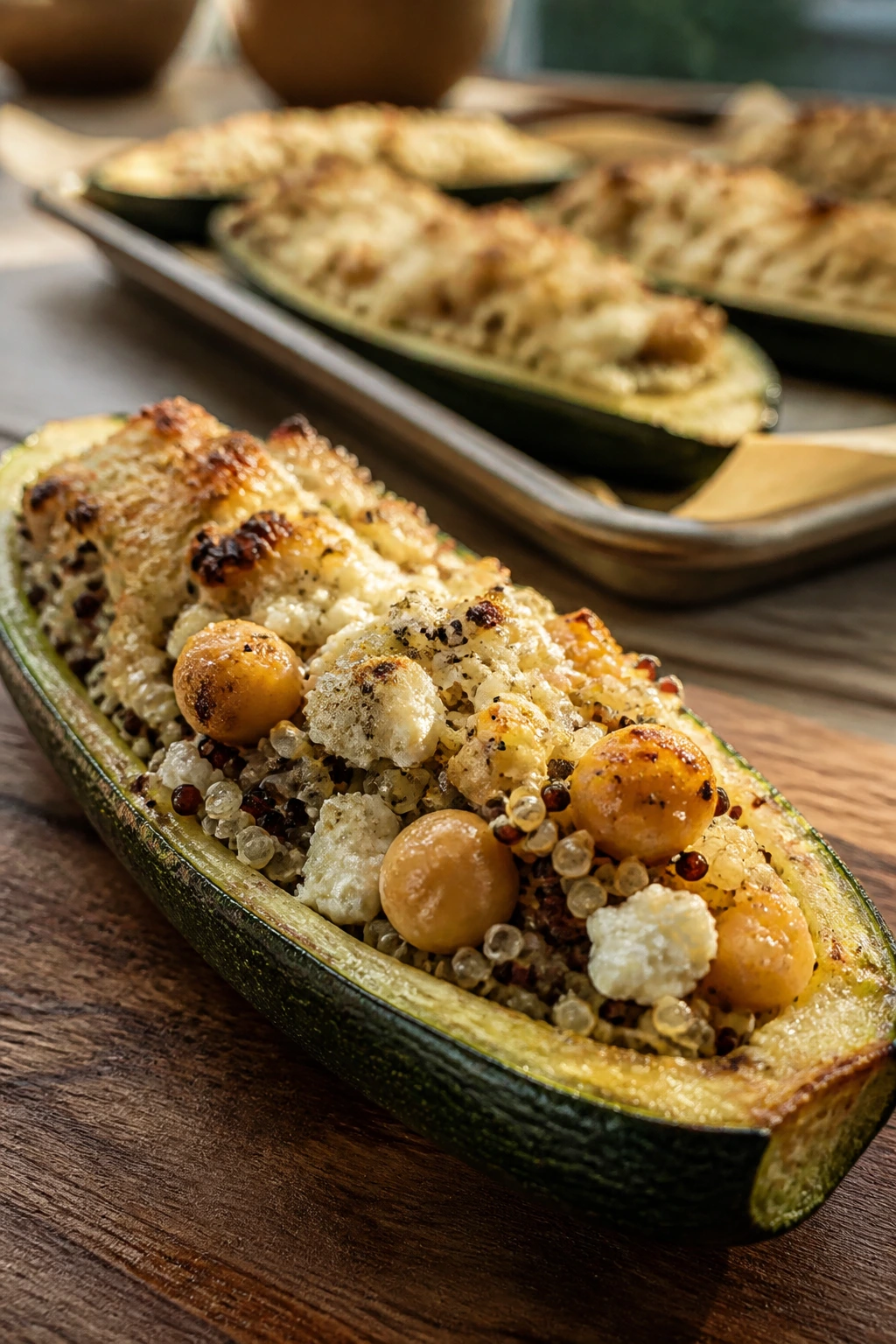
Some stuffed vegetable recipes collapse under the weight of their own filling. This one doesn’t.
- Garlic with depth: The garlic cooks with onion and tomato paste, so the filling tastes savory and rounded instead of raw or bitter.
- A real main dish: Quinoa, chickpeas, feta, and Parmesan give each serving enough protein, salt, and texture to stand on its own.
- Flexible vegetables: Zucchini, peppers, and mushrooms roast on the same tray, so you can use whatever mix looks best at the market.
- Two textures, not one mushy middle: The shells go tender at the edges while the filling stays a little chewy from quinoa and lightly mashed chickpeas.
- Easy to make ahead: The filling holds for a day in the fridge, which means most of the work disappears before dinner starts.
- Less cleanup than it looks: One skillet handles the filling, one pan handles the bake, and that’s the whole story.
Timing, Yield, and Difficulty at a Glance
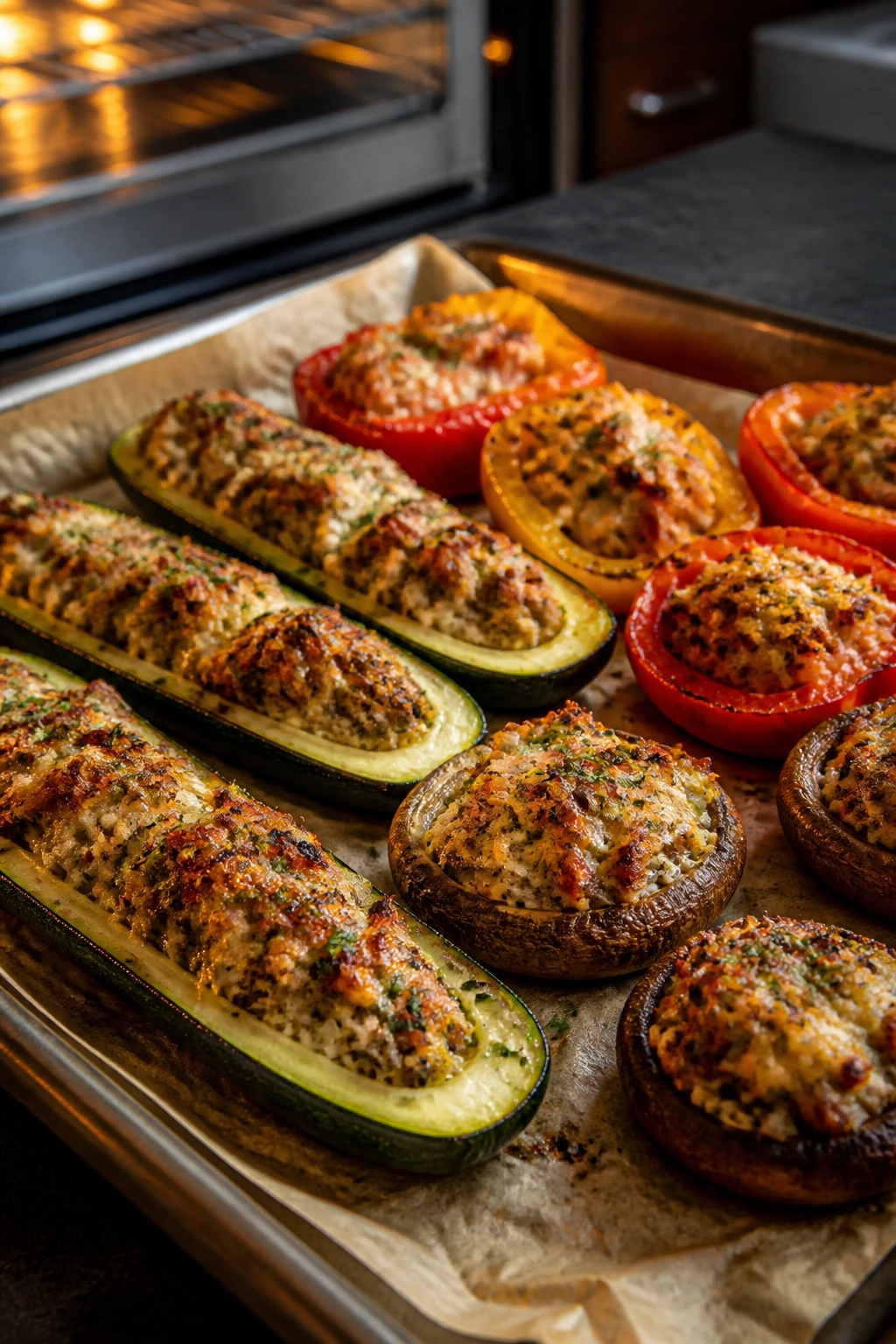
If you’re chopping before dinner, this is the part that helps.
Yield: Serves 4 as a main dish, or 6 if you add salad and bread.
Prep Time: 25 minutes
Cook Time: 35 minutes
Total Time: 1 hour
Difficulty: Intermediate — the recipe itself is simple, but the vegetable shells, filling, and bake time each need a little attention.
Chill/Rest Time: 5 minutes after baking
Best Served: Warm, when the cheese has melted and the lemon still tastes bright
What Goes Into the Tray
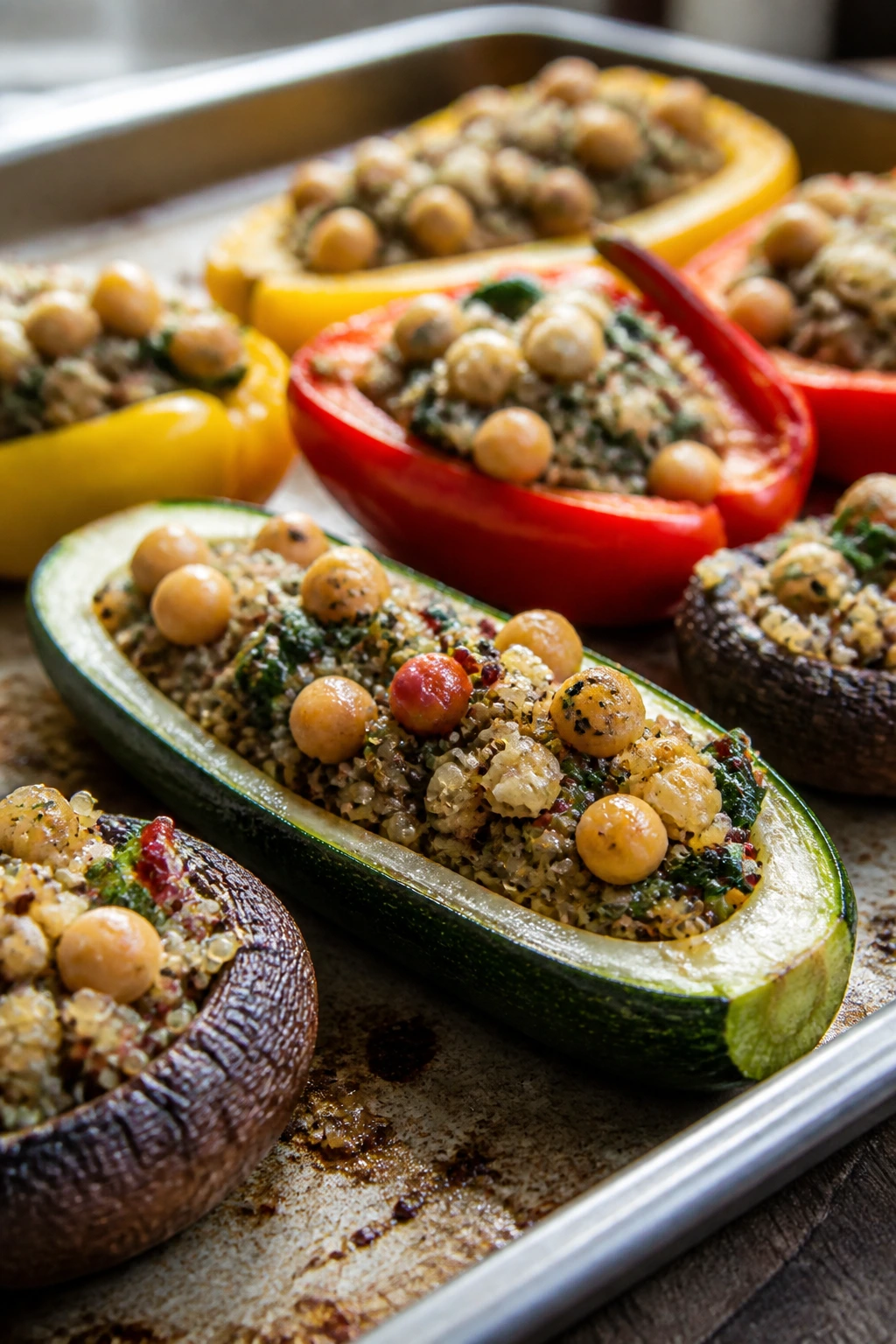
The ingredient list is short, but each piece has a job. If one part is weak — watery vegetables, bland grains, too little salt — you feel it in the final bite.
For the Vegetable Shells:
- 2 medium zucchini, halved lengthwise and lightly scooped
- 2 large red bell peppers, halved lengthwise and seeded
- 4 large portobello mushroom caps, stems removed and gills scraped
- 2 tablespoons olive oil
- 1 teaspoon kosher salt
- 1/2 teaspoon black pepper
For the Garlicky Filling:
- 1 tablespoon olive oil
- 1 small yellow onion, finely diced
- 6 garlic cloves, minced
- 1 cup finely chopped portobello stems or cremini mushrooms
- 2 tablespoons tomato paste
- 1 cup cooked quinoa, cooled
- 1 (15-ounce) can chickpeas, drained, rinsed, and lightly mashed with a fork
- 1 cup cherry tomatoes, quartered
- 2 cups baby spinach, chopped
- 1/2 cup crumbled feta
- 1/4 cup grated Parmesan
- 1/4 cup whole-wheat panko breadcrumbs
- 2 tablespoons chopped parsley
- 1 tablespoon lemon juice
- 1 teaspoon lemon zest
- 1 teaspoon dried oregano
- 1/2 teaspoon crushed red pepper flakes
- 1/2 teaspoon kosher salt, plus more to taste
- 1/2 teaspoon black pepper, plus more to taste
- 1 to 2 tablespoons water, only if the filling looks dry
- 1 tablespoon extra olive oil, for drizzling before baking
Why These Ingredients Work Better Together
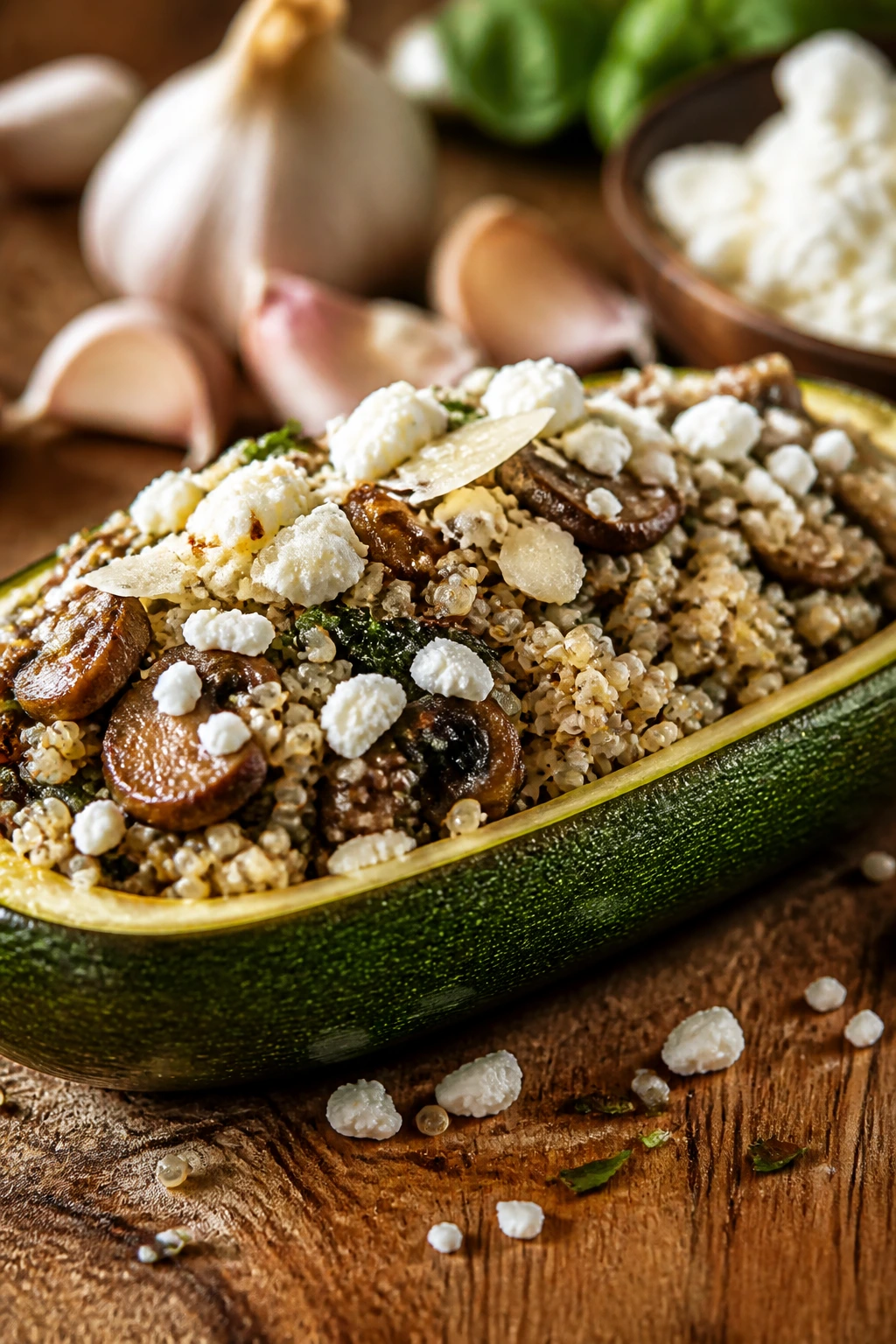
Why does this combination taste rich without feeling heavy? Because every ingredient is covering a different job, and none of them has to do all the work.
The Vegetable Shells
What to use: 2 medium zucchini, 2 large red bell peppers, and 4 large portobello caps.
Preparation: Halve the zucchini lengthwise and scrape out a shallow trough, leaving a 1/4-inch wall so the boats hold their shape. Scrape the mushroom gills from the portobellos; they’re edible, but they make the filling look muddy and they leak more liquid than you want.
Substitutions: Yellow squash can replace zucchini, orange or yellow peppers work in place of red, and small eggplant halves are a good swap if you want a softer, meatier shell.
Tips: Choose vegetables with flat bottoms and firm skin. If a pepper half rocks around on the tray, it will dump filling the second you move it.
The Garlicky Filling
What to use: 1 small onion, 6 garlic cloves, 1 cup chopped portobello stems, 2 tablespoons tomato paste, 1 cup cooked quinoa, 1 can chickpeas, 1 cup cherry tomatoes, and 2 cups spinach.
Preparation: Cook the onion until translucent and the mushroom stems until their moisture has mostly evaporated. The quinoa should be cooled, not steaming hot, or the whole mixture turns sticky and soft.
Substitutions: Brown rice, farro, or couscous can stand in for quinoa if that’s what you have. Lentils also work, though they make the filling denser and a little earthier.
Tips: Tomato paste matters here. Let it darken in the skillet for a minute before you add the rest of the filling; that small step gives the dish a roasted, almost sweet backbone that plain cooked tomato can’t match.
Cheese and Crunch
What to use: 1/2 cup feta, 1/4 cup Parmesan, and 1/4 cup whole-wheat panko.
Preparation: Fold the feta into the warm filling so it softens without disappearing, then scatter the Parmesan on top before the final bake. The panko should go in last so it keeps some texture.
Substitutions: Goat cheese gives a tangier result, ricotta salata is saltier and drier, and gluten-free crumbs work fine if that’s what you keep in the pantry.
Tips: Don’t drown the filling in cheese. A modest amount gives you pockets of salt and creaminess; too much turns the inside pasty and masks the garlic.
Bright Finish and Spice
What to use: 2 tablespoons parsley, 1 tablespoon lemon juice, 1 teaspoon lemon zest, 1 teaspoon dried oregano, and 1/2 teaspoon crushed red pepper flakes.
Preparation: Stir the parsley and lemon juice in after the skillet comes off the heat so the flavor stays sharp. Zest the lemon before you juice it; that’s one of those small kitchen habits that saves annoyance later.
Substitutions: Dill, basil, or mint can replace parsley if you want a different herb note. If you like more heat, harissa or a pinch of Calabrian chili paste fits without throwing the recipe off balance.
Tips: The lemon should taste noticeable, not sour. You want the finished tray to feel lively at the edges, because roasted vegetables can drift bland fast if the acid is missing.
Tools That Make Stuffing Easier
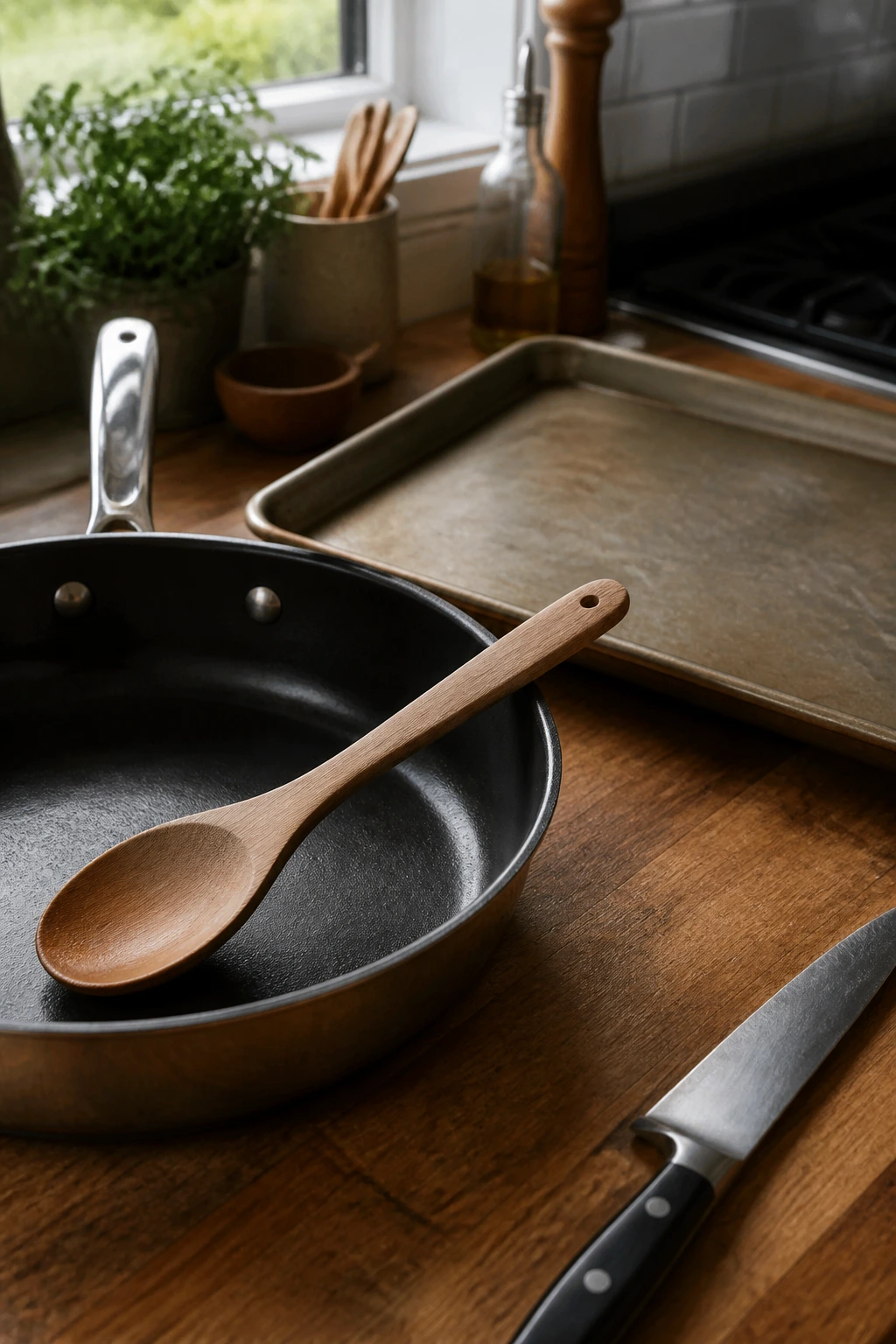
You don’t need a kitchen full of gadgets for this, but the right few tools make the prep much less fussy.
- Rimmed baking sheet or 9×13-inch baking dish — A sheet pan gives more browning; a baking dish holds juices if your vegetables are extra soft.
- Large skillet, 10- to 12-inch — Big enough to cook the onion, mushroom stems, and quinoa mixture without steaming it.
- Sharp paring knife or small spoon — Useful for scooping the zucchini centers and cleaning out pepper seeds.
- Melon baller or teaspoon — Optional, but it makes hollowing zucchini faster and cleaner.
- Mixing bowl — Handy if you want to cool the filling slightly before stuffing.
- Wooden spoon or stiff spatula — Better than a soft silicone spatula for pressing the filling together.
- Measuring spoons and cups — Keep the quinoa, tomato paste, and cheese amounts consistent.
- Parchment paper or foil — Optional, but cleanup is much easier when the vegetables release juice.
Roast, Fill, and Finish the Vegetables
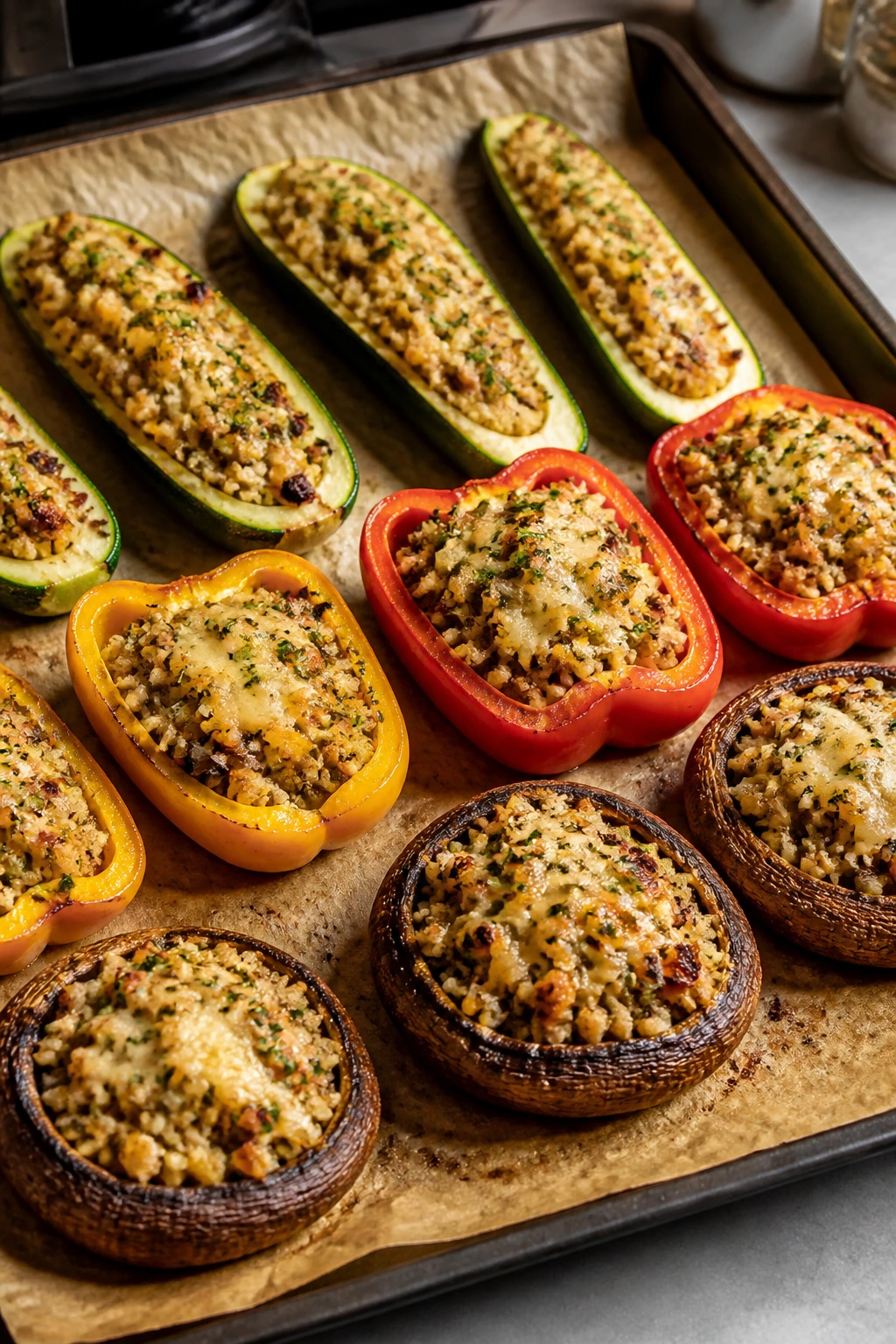
Do the vegetable prep first. Seriously. The filling is the easy part; the shells decide whether the whole pan looks neat or slumped.
Prep the Shells
- Preheat the oven to 425°F (220°C) and line a rimmed baking sheet with parchment paper or foil. Set the rack in the center of the oven so the vegetables cook evenly and the tops don’t brown too quickly.
- Prepare the vegetables. Halve the zucchini lengthwise and scoop out a shallow trough with a spoon, leaving a firm wall on the sides and bottom. Halve the peppers lengthwise, seed them, and scrape the mushroom gills out with a spoon.
- Season the shells. Brush the cut sides and inside surfaces with 2 tablespoons olive oil, then sprinkle with the salt and black pepper. Arrange them cut side up on the baking sheet.
- Roast for 10 minutes. The zucchini should just begin to soften at the edges, the peppers should start to droop a little, and the mushrooms should release a bit of juice. Do not skip this step; raw zucchini leaks water into the filling and peppers need a head start.
Build the Filling
- Cook the onion and mushroom stems. Heat 1 tablespoon olive oil in a large skillet over medium heat. Add the onion and chopped mushroom stems, then cook for 5 to 6 minutes, stirring often, until the onion turns translucent and the mushroom moisture has mostly cooked off.
- Add the garlic and tomato paste. Stir in the minced garlic and tomato paste, then cook for 1 minute, stirring constantly, until the tomato paste darkens slightly and the garlic smells sweet, not sharp.
- Stir in the filling ingredients. Add the quinoa, chickpeas, cherry tomatoes, spinach, feta, Parmesan, panko, parsley, lemon juice, lemon zest, oregano, crushed red pepper flakes, salt, and black pepper. Cook for 2 to 3 minutes, stirring, until the spinach wilts and the tomatoes soften just a little. If the mixture looks dry, add 1 to 2 tablespoons water so it holds together when pressed.
- Taste and adjust. The filling should taste a little bold on its own — a touch salty, a touch bright, and clearly garlicky. If it tastes flat in the skillet, it will taste flat after baking.
Stuff and Bake
- Fill the vegetables. Spoon the mixture into the par-roasted shells, mounding it slightly above the edges. Pack it lightly; you want the filling to stay in place, not turn into a brick.
- Finish and bake. Scatter the Parmesan over the top, drizzle with the remaining 1 tablespoon olive oil, and bake for 15 to 18 minutes, until the vegetables are tender enough to cut with a fork and the tops are lightly browned. If you want extra color, broil for 1 to 2 minutes at the end, watching closely so the cheese does not burn.
- Rest before serving. Let the tray sit for 5 minutes, then finish with a little extra parsley and a final squeeze of lemon juice. That short rest keeps the filling from sliding out the second you cut into it.
How to Serve the Finished Tray
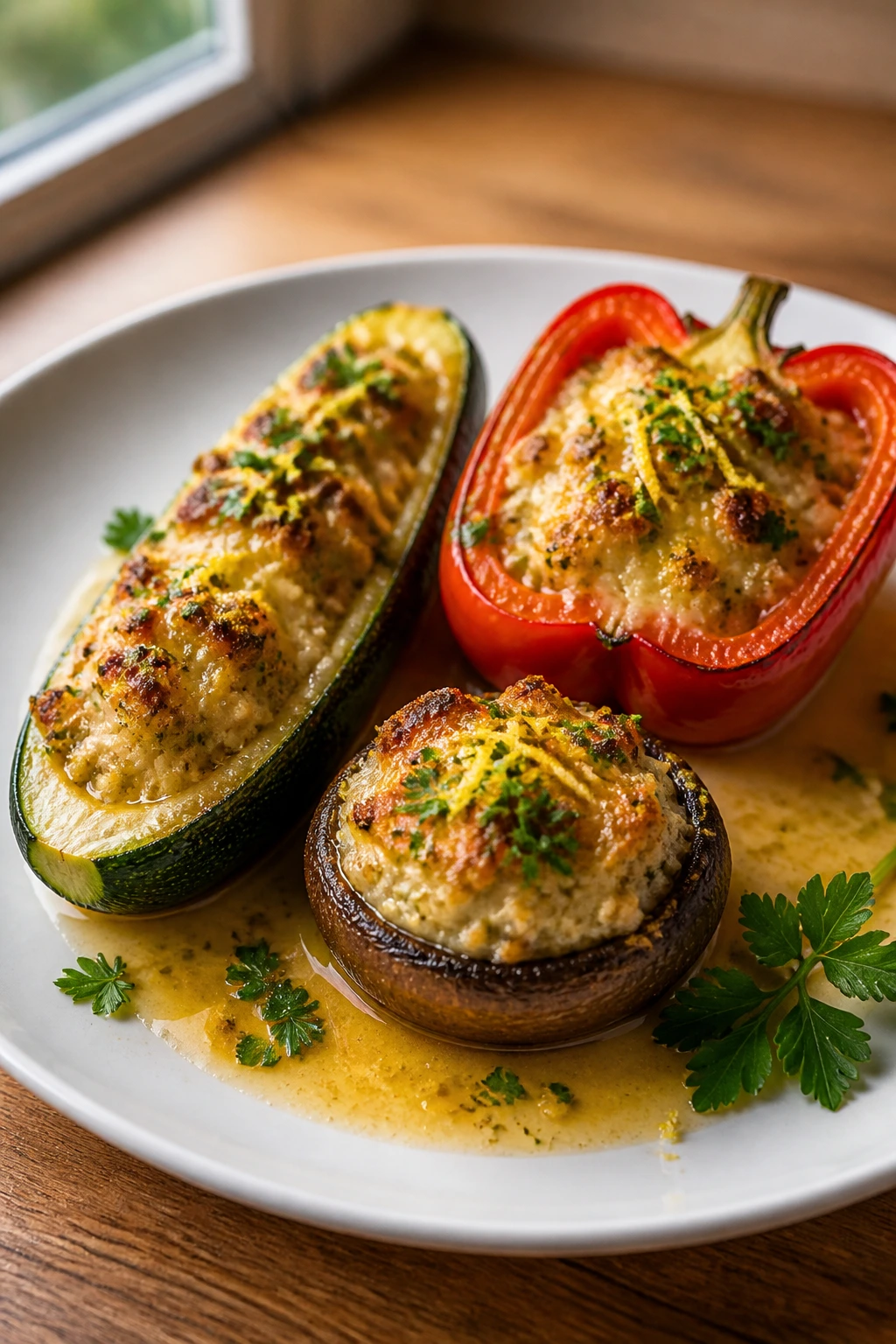
A tray of stuffed veggies can look fussy if you crowd the plate, so keep the serving style clean.
Presentation: Put one zucchini boat, one pepper half, and one mushroom cap on each plate if you’re serving a mixed tray. Spoon any juices from the pan around the vegetables, not over the top, so the browned cheese stays visible. A pinch of parsley and a little lemon zest at the end make the dish look fresher than it is.
Accompaniments: A sharp arugula salad is the easiest partner because the peppery greens cut through the cheese and garlic. If you want something more filling, add crusty sourdough, warm pita, or a scoop of plain rice. A spoonful of yogurt mixed with lemon and a tiny grated garlic clove gives the plate a cool, tangy edge.
Portions: Plan on one zucchini half, one pepper half, and one or two mushroom caps per adult. For a lighter meal, serve one stuffed vegetable with salad; for hungrier eaters, add bread and another scoop of quinoa or rice on the side.
Beverage Pairing: A crisp white wine like sauvignon blanc fits the lemon and garlic nicely, and sparkling water with lemon does the same job without any fuss. If you prefer red, pick something light and low in oak so it doesn’t bulldoze the vegetables.
Small Moves That Improve the Whole Pan
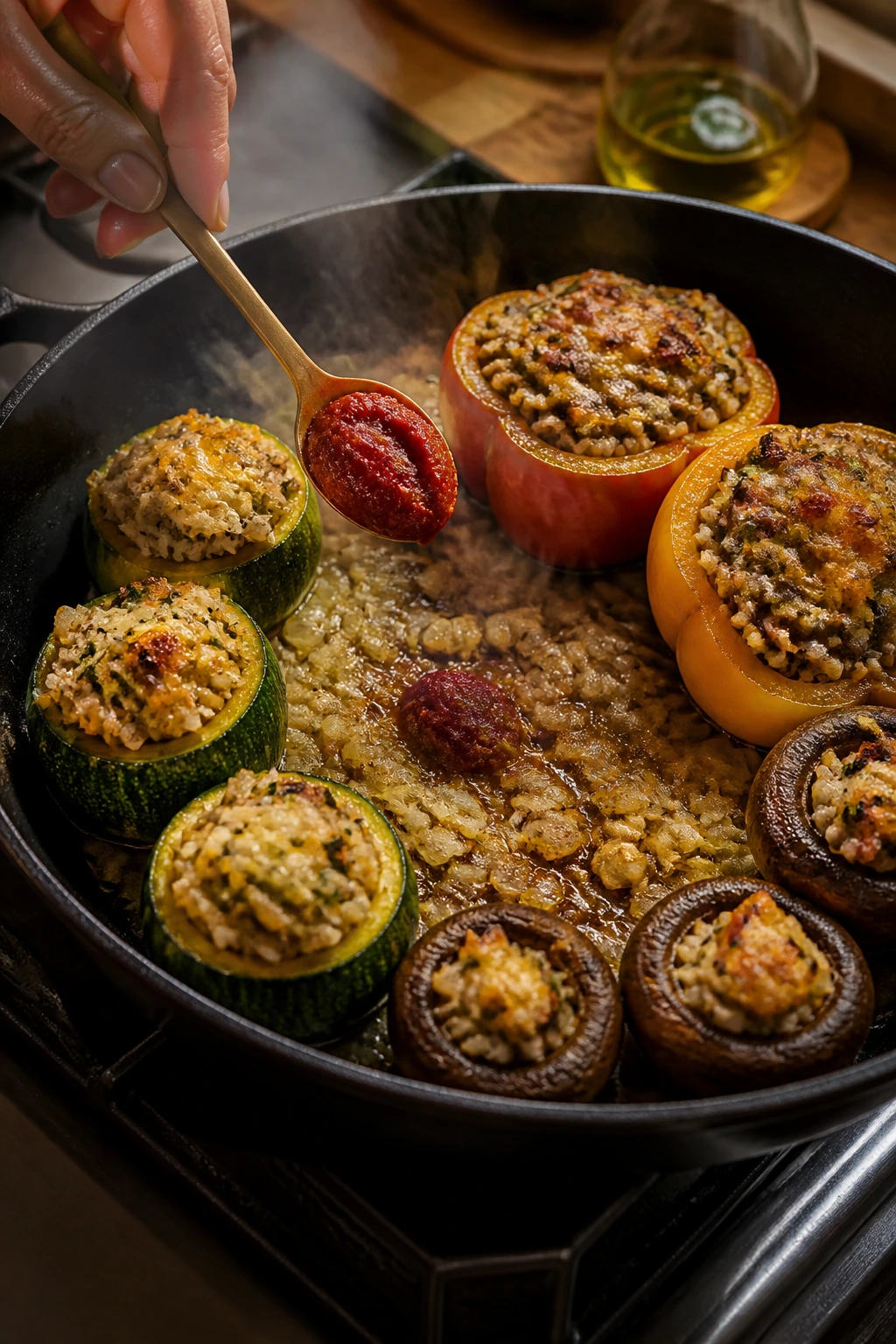
A few small tweaks make a bigger difference here than they do in many baked dishes. The ingredients are already doing a lot of work; the trick is not to get in their way.
Flavor Enhancement: Stir a spoonful of tomato paste into the onions and let it darken before the garlic goes in. That small bit of caramelization gives the filling more depth than extra salt ever will. If you like a brighter finish, add a second squeeze of lemon after baking instead of more cheese.
Time-Saver: Cook the quinoa a day ahead or use leftover grains from another meal. Cold grains actually help the filling hold together better, and the stuffing step goes faster when you’re not waiting for steam to settle.
Cost-Saver: Buy whichever peppers look best and skip the prettiest, most expensive one if the price is out of line. You can also use a little less feta and lean harder on Parmesan, which brings salt and structure at a lower cost per ounce.
Make-It-Yours: Add chopped olives for brininess, toasted pine nuts for crunch, or chopped sun-dried tomatoes for a sweeter, denser filling. If you want a vegan version without changing the shape of the recipe, swap the cheeses for 3 tablespoons nutritional yeast plus 1 tablespoon tahini.
Common Stuffing Mistakes and How to Avoid Them
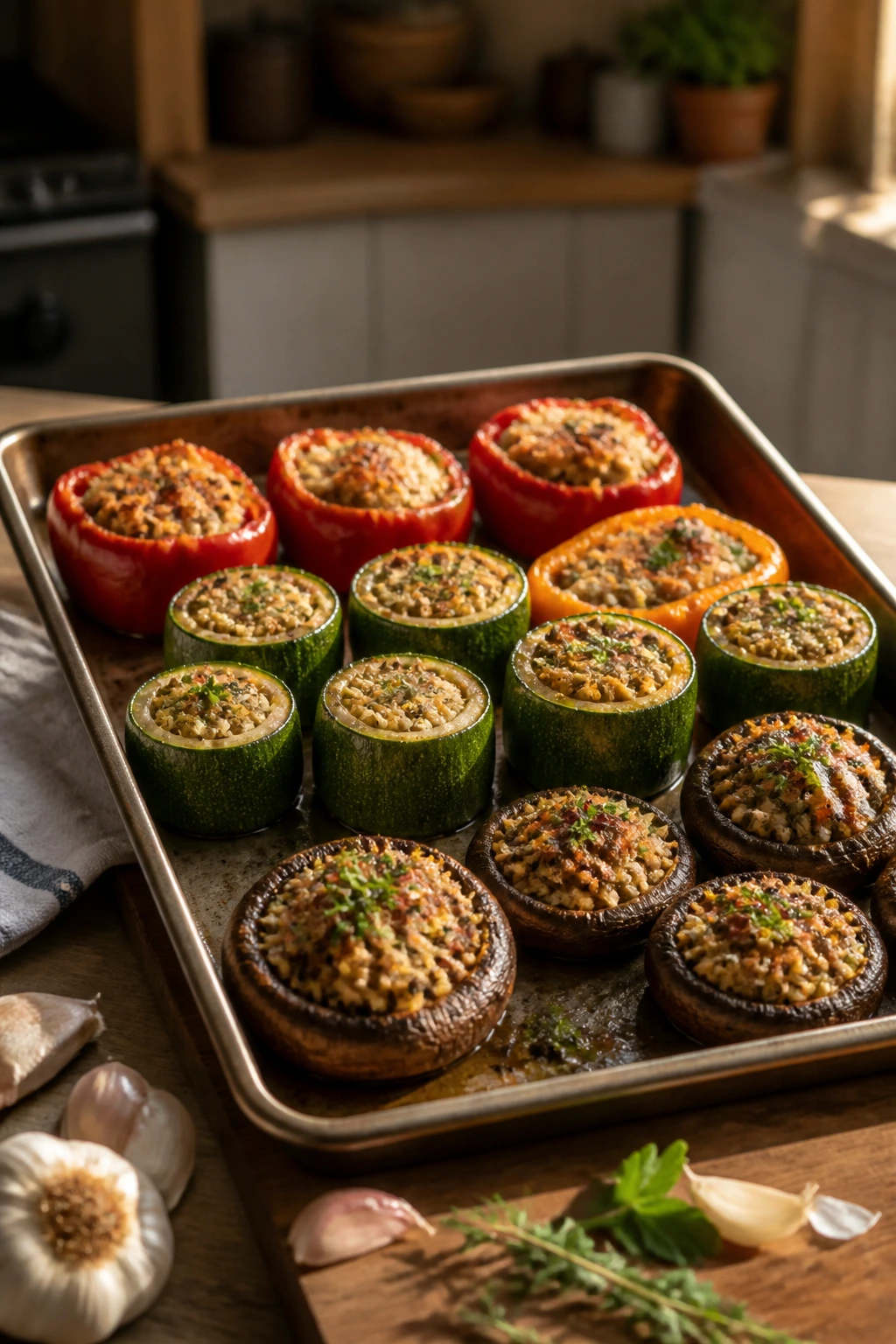
Watery filling is the usual problem, but it is not the only one. Stuffed vegetables fail in small, boring ways.
- Skipping the par-roast. The zucchini turns soft and dumps liquid into the filling, and the peppers stay too firm in the center. Roast the empty shells for 10 minutes first, then fill them.
- Leaving the filling wet. If the skillet still looks glossy with liquid, the final bake turns heavy and the bottoms slide. Cook the onion, mushrooms, and tomato paste long enough for the moisture to evaporate before you add the grains.
- Under-seasoning the vegetables. A perfect filling can still taste flat if the shells got no salt and oil before baking. Brush and season the cut sides before they go in the oven, not after.
- Packing the filling too tightly. A hard-packed mound looks neat, but it turns dense and can split the vegetable walls. Spoon it in with a little pressure, then stop once it sits above the rim.
- Baking until everything is soft-soft. The peppers start collapsing and the mushrooms go floppy if you wait for a deeply browned top. Pull the tray when the vegetables are tender and the edges still have shape.
- Using giant zucchini. Oversized zucchini have watery centers and thick skins, which makes them hard to hollow and easy to overbake. Medium zucchini, about 8 to 9 inches long, are much easier to manage.
Four Ways to Change the Flavor Without Breaking the Recipe
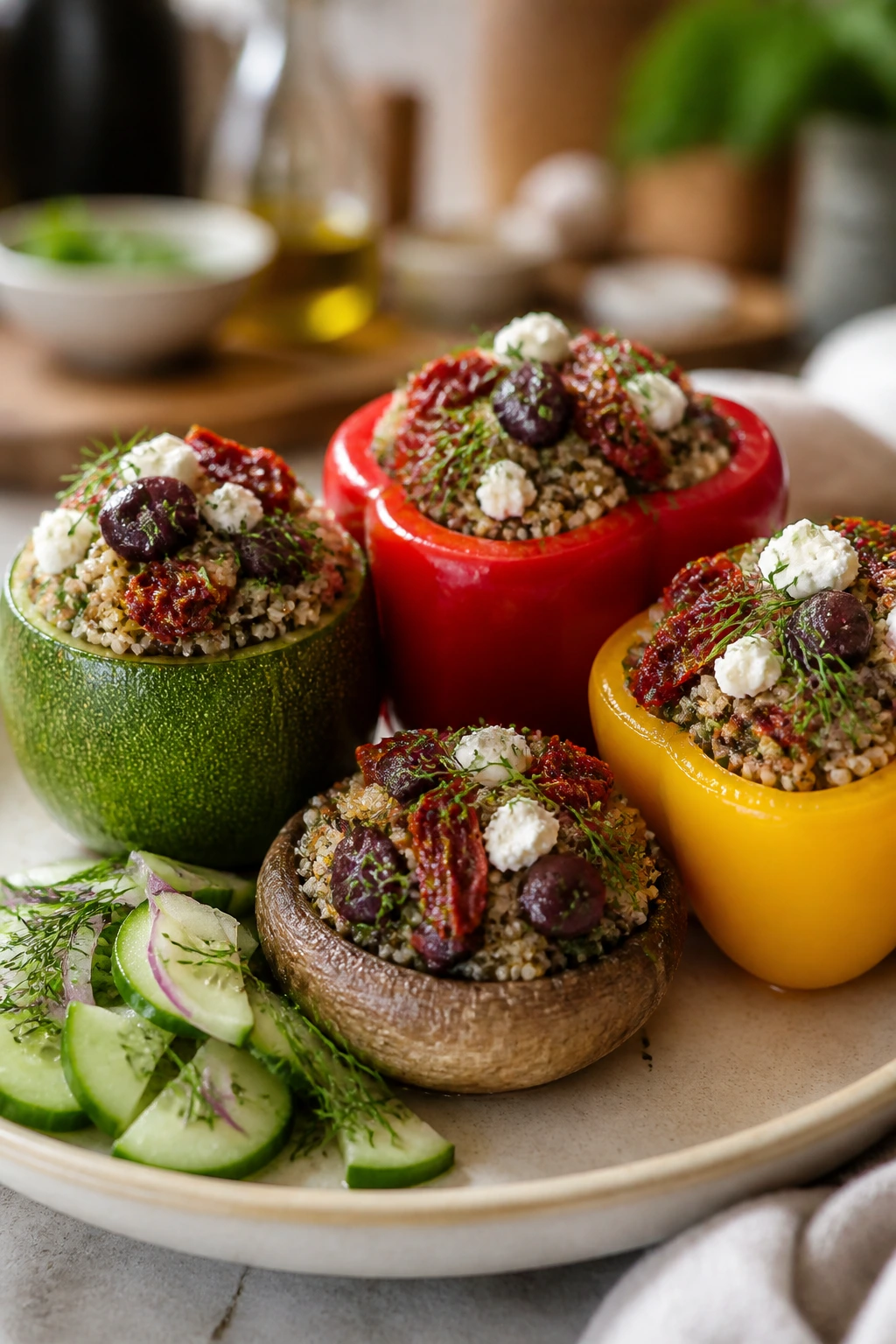
The base recipe can go in a few directions without turning weird. That’s one reason I keep coming back to stuffed vegetables.
Mediterranean Market Tray
Add 1/4 cup chopped Kalamata olives and 2 tablespoons chopped sun-dried tomatoes to the filling. Swap parsley for dill, keep the lemon, and use goat cheese in place of feta if you want a softer, tangier finish. This version loves a bowl of cucumber salad beside it.
Vegan Garlic Garden
Leave out the feta and Parmesan, then add 3 tablespoons nutritional yeast and 1 tablespoon tahini to the filling for body and a little richness. Use extra panko for structure if the mixture feels loose. It still tastes garlicky and satisfying, just with a softer, nuttier finish.
Spicy Red Pepper Version
Stir 1 teaspoon Calabrian chili paste or another 1/2 teaspoon crushed red pepper flakes into the skillet with the tomato paste. Finish with a few drops of chili oil after baking if you want a sharper kick. This one works well with peppers and mushrooms because they handle heat without getting lost.
Tomato-Basil Bake
Spoon 1/2 cup marinara into the bottom of the baking dish before you add the stuffed vegetables. Replace the oregano with chopped basil, and use mozzarella on top instead of Parmesan if you want a softer, meltier cap. The sauce keeps the tray juicier and gives the dish a more red-sauce feel.
Make-Ahead, Storage, and Reheating
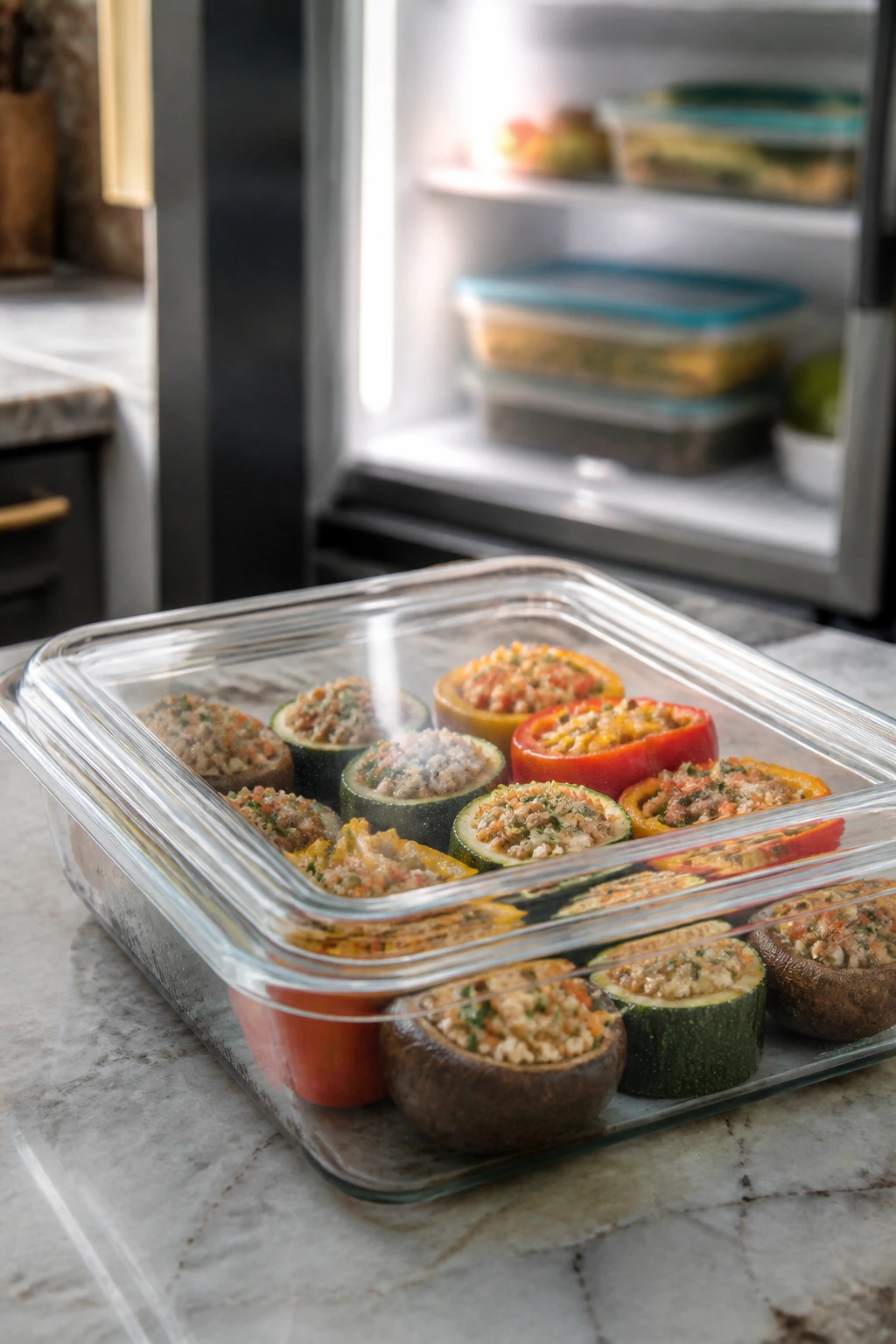
Stuffed vegetables keep, but they do not behave like soup or stew. The shells continue to soften as they sit, and zucchini in particular will give up a little more moisture after baking.
If you want to get ahead, make the filling up to 1 day in advance and refrigerate it in an airtight container. You can also pre-roast the vegetable shells earlier in the day, then stuff and bake them just before dinner. For the smoothest workflow, assemble the tray up to 8 hours ahead, cover it, and keep it in the fridge until you’re ready to bake.
Leftovers keep in the refrigerator for 3 to 4 days in a sealed container. They are safe at room temperature for up to 2 hours, or 1 hour if the kitchen is hot and the tray is sitting out during a long meal. The zucchini softens a little more on day two, but the flavor usually deepens nicely because the garlic, lemon, and herbs settle in.
For freezing, the filling does better than the fully baked vegetables. Packed on its own, the filling keeps for up to 2 months in the freezer. The assembled baked vegetables can also be frozen for up to 2 months, but expect the zucchini to soften after thawing; peppers and mushrooms hold up better. Thaw overnight in the fridge before reheating if you can.
Reheat leftovers in a 350°F (175°C) oven for 15 to 20 minutes, covered loosely with foil so the tops do not dry out. If you want the Parmesan to crisp again, uncover for the last 5 minutes. A microwave works in a pinch — use medium power and short bursts — but it softens the shells faster than the oven does. For food safety, reheat until the center reaches 165°F.
Questions People Ask Before Making Stuffed Veggies
Can I make this ahead of time?
Yes. The filling can be cooked a day ahead, and the vegetables can be pre-roasted earlier in the day so the final bake is shorter. If you assemble the whole tray ahead, keep it covered in the fridge and add 3 to 5 minutes to the bake time.
What vegetables work best if I don’t want zucchini, peppers, and mushrooms?
Small eggplant halves, large tomatoes, and delicata squash all take stuffing well, though their baking times differ. Eggplant needs a longer roast and a little more oil, while tomatoes need less time because they break down fast. Use the same filling and adjust the shell until it feels tender but still sturdy.
Can I use rice instead of quinoa?
Yes, as long as the rice is already cooked and not wet. Leftover brown rice is especially good here because it stays a little chewy in the oven, while jasmine rice makes the filling softer. Keep the amount the same: 1 cup cooked rice.
How do I keep the vegetables from getting watery?
Pre-roast the shells, cook off the moisture in the skillet, and don’t overdo the tomatoes. Zucchini and mushrooms release the most liquid, so if you see a puddle in the pan before baking, keep cooking the filling for another minute or two.
Can I make it dairy-free?
Yes. Skip the feta and Parmesan, then add 3 tablespoons nutritional yeast and 1 tablespoon tahini or a spoonful of chopped olives for body and salt. The filling will be less creamy, but it still tastes full and garlicky.
Do I have to peel the zucchini?
No. The skin helps the boats hold together and gives the finished dish a better shape. Peel only if the zucchini skin is unusually thick or tough, which is rare if you choose medium vegetables.
What if the tops brown before the vegetables are tender?
Cover the tray loosely with foil and keep baking until the shells are soft enough to cut with a fork. Then uncover for the last 2 minutes if you want a little more color. This happens more often with thicker peppers or a very hot oven rack.
Can I freeze the leftovers?
You can, but the texture softens, especially in the zucchini. For the best result, freeze the filling separately and stuff fresh shells later. If you do freeze the baked vegetables, thaw them in the fridge overnight before reheating.
A Tray Worth Repeating
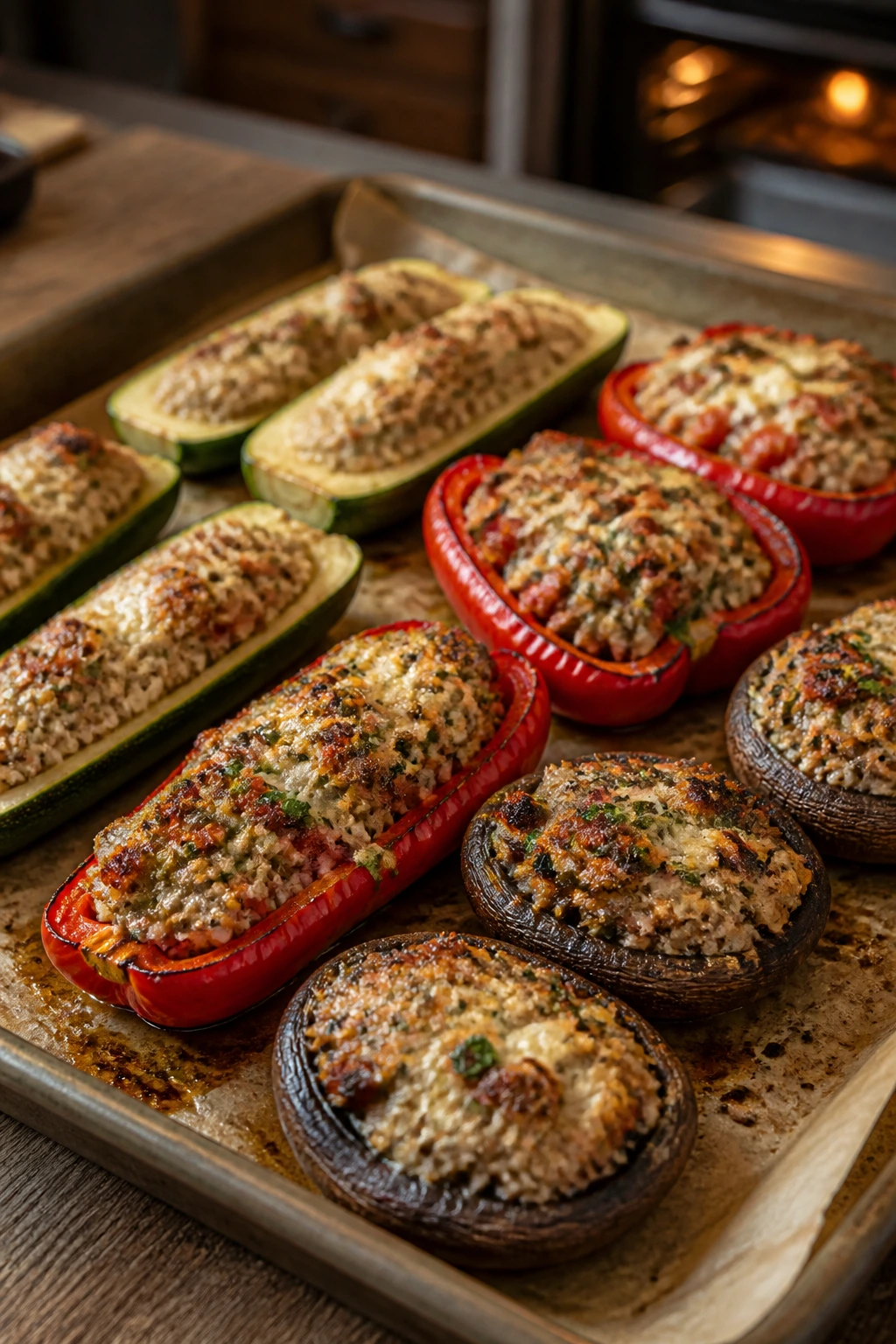
Garlicky stuffed veggies earn their place because they taste like dinner, not a side dish pretending to be something else. The vegetables stay distinct, the filling has real flavor, and the whole tray lands in that sweet spot between hearty and light.
Keep the method the same and swap the produce, cheese, or grain, and the dinner still works. That’s the part I like best: once you know the structure, the recipe stops feeling fragile and starts acting like a habit.
Garlicky Stuffed Veggies — Recipe Card
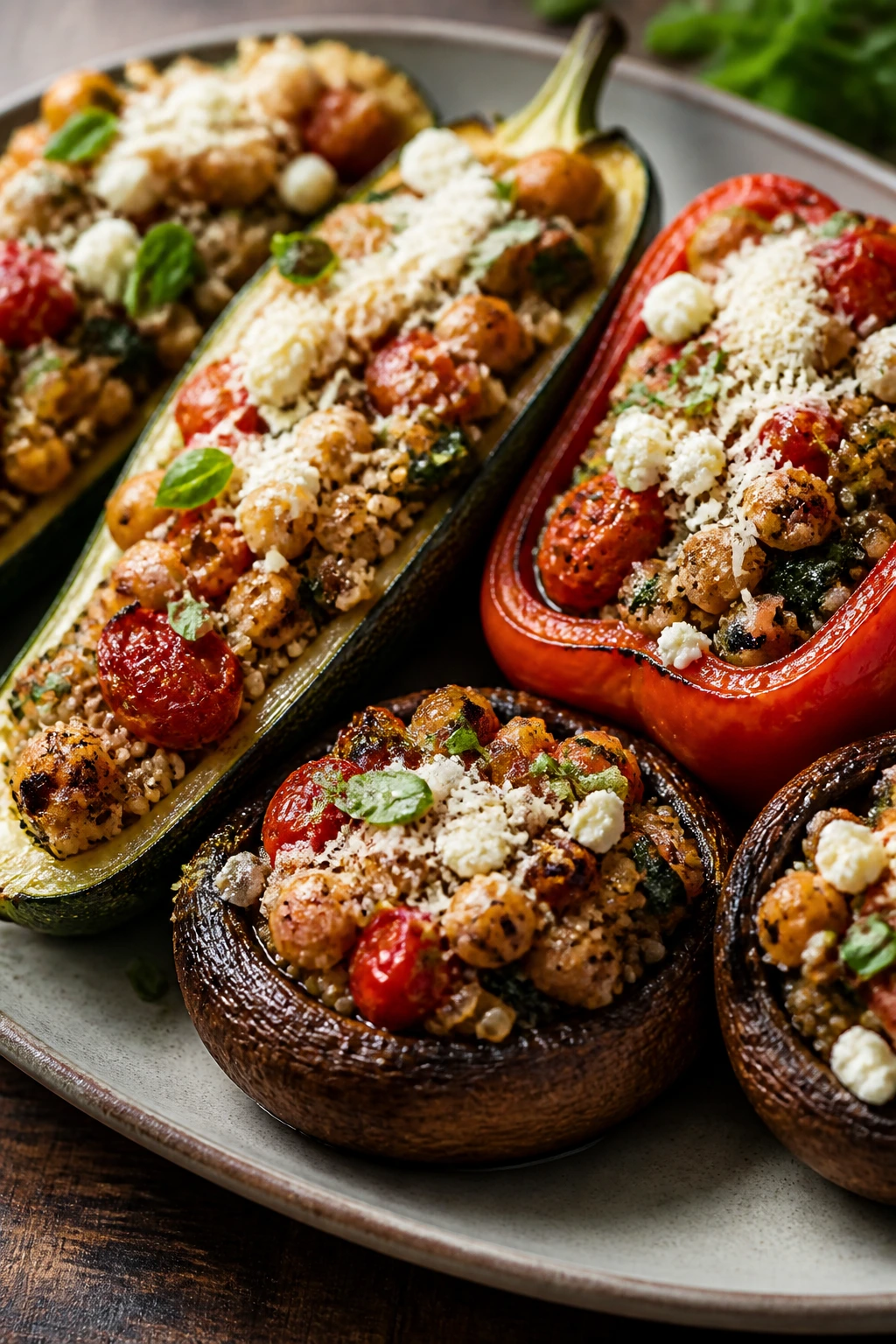
Recipe Name: Garlicky Stuffed Veggies for a Healthy Dinner
Description: Roasted zucchini, red bell peppers, and portobello mushrooms stuffed with a garlicky quinoa-chickpea filling, tomatoes, spinach, feta, Parmesan, and lemon.
Prep Time: 25 minutes
Cook Time: 35 minutes
Total Time: 1 hour
Course: Dinner, Main Course
Cuisine: Mediterranean-Inspired Vegetarian
Servings: 4 servings
Calories: About 350 kcal per serving
Ingredients
For the Vegetable Shells:
- 2 medium zucchini, halved lengthwise and lightly scooped
- 2 large red bell peppers, halved lengthwise and seeded
- 4 large portobello mushroom caps, stems removed and gills scraped
- 2 tablespoons olive oil
- 1 teaspoon kosher salt
- 1/2 teaspoon black pepper
For the Garlicky Filling:
- 1 tablespoon olive oil
- 1 small yellow onion, finely diced
- 6 garlic cloves, minced
- 1 cup finely chopped portobello stems or cremini mushrooms
- 2 tablespoons tomato paste
- 1 cup cooked quinoa, cooled
- 1 (15-ounce) can chickpeas, drained, rinsed, and lightly mashed with a fork
- 1 cup cherry tomatoes, quartered
- 2 cups baby spinach, chopped
- 1/2 cup crumbled feta
- 1/4 cup grated Parmesan
- 1/4 cup whole-wheat panko breadcrumbs
- 2 tablespoons chopped parsley
- 1 tablespoon lemon juice
- 1 teaspoon lemon zest
- 1 teaspoon dried oregano
- 1/2 teaspoon crushed red pepper flakes
- 1/2 teaspoon kosher salt
- 1/2 teaspoon black pepper
- 1 to 2 tablespoons water, only if needed
- 1 tablespoon extra olive oil, for drizzling
Instructions
- Preheat the oven to 425°F (220°C) and line a rimmed baking sheet with parchment paper or foil.
- Halve the zucchini, scoop out a shallow trough, halve and seed the peppers, and scrape the mushroom gills. Brush the cut sides with olive oil, then season with salt and black pepper.
- Roast the empty vegetable shells for 10 minutes until the zucchini edges soften and the mushrooms release a little moisture.
- Heat olive oil in a skillet over medium heat. Cook the onion and chopped mushroom stems for 5 to 6 minutes, then add the garlic and tomato paste and cook for 1 minute.
- Stir in the quinoa, chickpeas, cherry tomatoes, spinach, feta, Parmesan, panko, parsley, lemon juice, lemon zest, oregano, red pepper flakes, salt, and black pepper. Add a little water only if the filling looks dry.
- Spoon the filling into the roasted vegetables, mound it slightly, scatter Parmesan over the top, and drizzle with the remaining olive oil.
- Bake for 15 to 18 minutes until tender and lightly browned. Broil for 1 to 2 minutes if you want extra color, then rest for 5 minutes before serving.
Notes: Roast the shells first or the filling will turn watery. For leftovers, reheat covered at 350°F until the center is hot, and finish with a fresh squeeze of lemon to wake up the flavors.